
 Shane Slater
Set against the backdrop of social and political instability in 1992 Peru, Klaudia Reynicke’s Reinas is a poignant family drama told from the perspective of its two young sisters. As their mother plans their migration, their estranged father attempts to reconcile with them, causing further complications within the family dynamic. Ahead of its world premiere at the 2024 Sundance Film Festival, Awards Radar chatted with Reynicke to discuss the casting and personal relevance of its story.
Shane Slater: What was the inspiration behind this film? It feels very personal.
Klaudia Reynicke: So it’s not autobiographical in the sense where everything happened like this. But yes, I left Peru when I was 10 years old with my mom and my stepdad. So I guess that’s the most autobiographical part. I think I just wanted to create a story that would talk about family in general. How a family that is not a family anymore gets reunited, before they split again. Which has happened in in my own life. So I would say it’s not an autobiography. But I know all these feelings very well.
SS: The film does a good job of conveying the social tensions, while also showing how, because of their privilege, they were somewhat sheltered from it. Could you tell me a bit more about how you approached the tone of the film?
KR: Already in the writing, it was difficult to find a balance of how to bring the political and social side of it, which was very important. And it was important to me to talk about it, because this is how I left Peru. And it’s kind of the reason why we left Peru. I guess my brain was stuck in that period of time.
So to me, it was very important to go back during the time that I actually knew Peru that well. But also, I feel in many countries of Latin America, every 10 years, it changes. Like, it can go really well and suddenly it’s not. So it’s like history repeats itself all the time. Now, things are not great in Venezuela. And at some point in Colombia, you know? So I feel it’s a very present story. But I didn’t want to make it a political story. It’s mainly a family story. So it was very hard to balance two things.
SS: Was there any specific memory that guided the perspective of the film?
KR: I left when I was 10, but we would go back once to twice a year until I was 15. Which is why I have the two ages that I know very well, because I was still very close to it. But then when I was 15, my family left to go to the west. So from Europe, we started going to the US until I moved there with my mom and my stepdad.
What I remember mainly about that period is the light going off, and sometimes not having light for a few days. And it was totally normal. So there was not a feeling of “Oh no!” As kids, we knew exactly what to do, and we continued to function. And the curfew had specific months where they put the curfew twice in that period. And I do remember one of the periods because stuff happened that the neighbors or members of the family have stories about. Like the story in the police station, that truly happened to someone.
So it was all inspired by things that the family told me later. As I was writing, I would call my aunts and cousins and be like, “Hey, do you remember any specifics?” And they were like, “Oh, yes, I remember this.” So my memory as a kid was very happy I would say, but then having discussions as an adult with other adults, I realized how scary it was for them. And how they would try to be cool about that with us. But obviously, they get used to it too, you know? Because with 10 to 15 years of this situation, you get used to it.
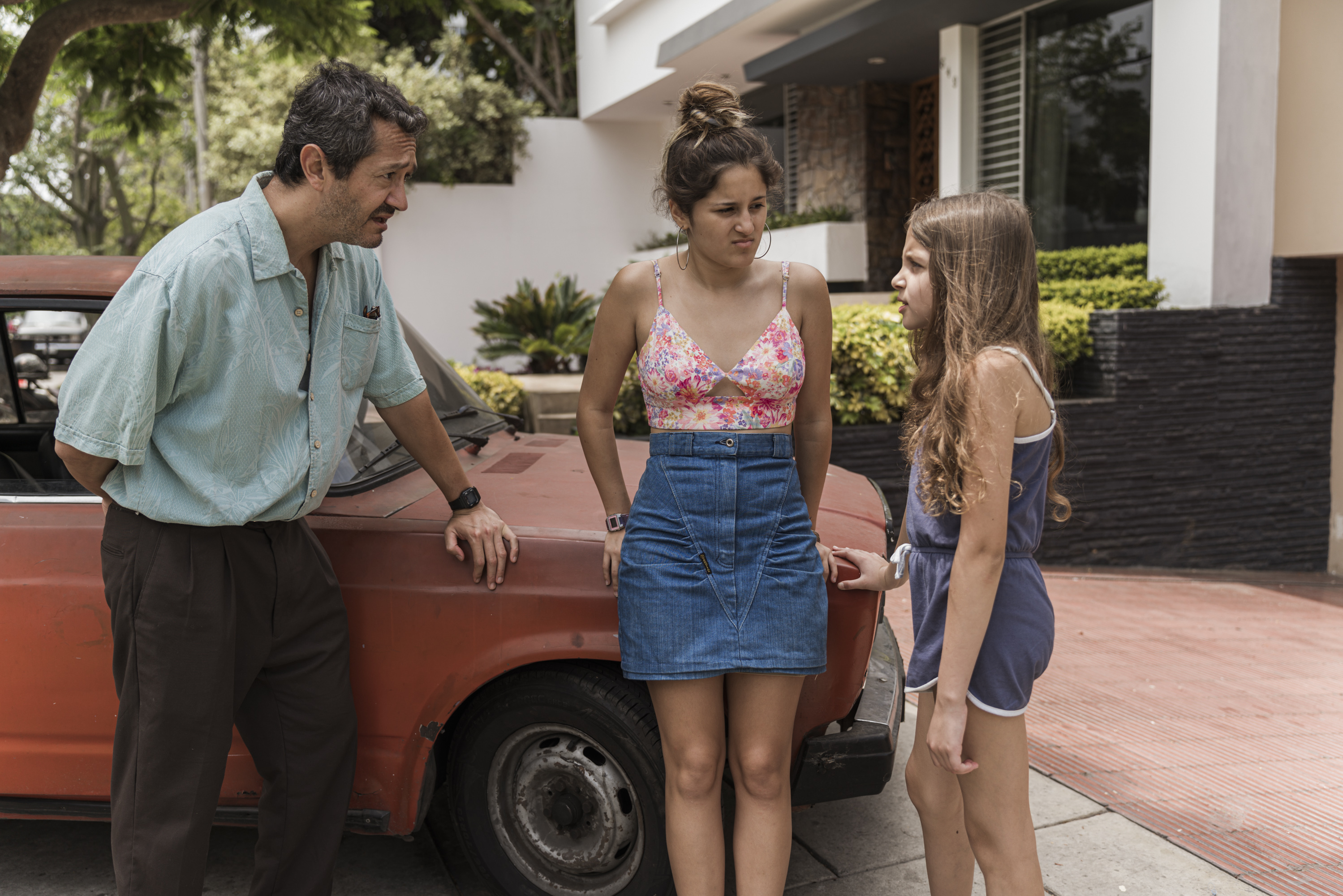
SS: I found the father character to be so sympathetic. How did you approach that character and working with Gonzalo Molina?
KR: Gonzalo is amazing. My biological father is a bit like this. He’s, at least from my point of view, a bit like this. But he left us when I was five years old. So he was not around at all. He didn’t come back. He still lives in America and he’s a funny guy. He’s very creative. None of the stories that Carlos says, are the stories that my real father said. But he could have said one of these stories.
Gonzalo Molina, when I met him, what struck me was his interior life. And I truly needed for this character to actually be loved. Even though he does all these awful things. He lies to his children, he’s very selfish in a way, because he’s not in a good place. But I needed the viewer not to hate him, and not to judge him. And I think I truly needed an actor that was able to bring this charisma. This very strange charisma, where he can do whatever he does, and it would be like, “Oh, Carlos!” [Laughs]. And you kind of feel bad for him, because you see he’s true to his failings.
Gonzalo Molina is just amazing. I mean, when I saw him, he made me laugh a lot. And he was just very humble. He’s a very humble person. And I feel also he’s very simple as a person and very warm. He’s very warm. And I love the contrast with Elena who’s a colder, practical, pragmatic kind of a character. She needs to be like this. She has raised her kids by herself, she has a job, she found a job overseas. So Carlos needs to be the opposite. He’s like, “Oh, I’m here. Now you can love only me.” And that’s what happens, and it happens to a lot of moms.
So Jimena Lindo was perfect in a way because, she’s obviously not cold as a person, but she can bring that and still be very loving with a kid. But she is pragmatic, and she needs to be. So the contrast was amazing.
SS: The two daughters are so integral to the story. How did you go about ensuring that you had the right actors to to play those two roles?
KR: It took a very long time, actually. We started casting before COVID and couldn’t find the girls. Then COVID hit and we stopped for one year. Then we took back up the search. And we were a month before shooting and I still didn’t have the girls. And at some point, the casting managers, they found Abril Gjurinovic, who plays Lucia, in a shopping mall in Lima. She was with her dad, and the description kind of fit what I wanted. And then she did the casting, and I saw it in Switzerland. I’m like, “Okay, I think I found her. I think it’s her.” And then I’m like, “Okay, let’s do a callback.” And then we couldn’t find her anymore. I’m like, “What are you talking about?” And they’re like, “Actually, we found out she doesn’t even live in Peru.”
We found out she was living in Belgium. And her story was very close to Lucia’s story actually. She left Peru with her mom and her father. And when she was at the shopping mall, she was visiting. So from Belgium, I could fly her here to Switzerland. And I did the casting in person. That was great. And this is literally three weeks before we all left to go shooting.
For Luana, that was really funny because I couldn’t find her. Her dad is the Peruvian co-producer Daniel Vega. And he’s also a screenwriter, and director. They do everything with his brother Diego, who co-wrote with me. And we are in a Zoom. And I’m still looking for our daughter. Then I see the daughter passing in the back. And I’m like, “Daniel, how old is your daughter again?” And he said 14. I’m like, “So, is she not interested?” And he said no, she’s absolutely not.
Because of him being a director and being in the industry, and the mom is also in the industry, Luana was like, “There’s no way I want to approach this at all. I’m not interested to ever be an actress. I hate it.” And I’m like, “Oh my God, send me pictures.” So he sends me pictures. And I’m like, “You know, I think we should try.” And then we got her to go with one of her friends who was gonna do the casting. So I told the casting people to try to convince Luana to do the casting as well, when she’s there. So when she was there, she did it. And then I saw it. And I’m like, “She’s amazing. It’s her.” So we convinced her to do the film.


Comments
Loading…