

 Myles Hughes
Ever since making his debut in 1954 (8 years before James Bond, one of the few long-running film franchises with a comparable cultural impact), Godzilla has been THE name in giant monster cinema against which all others are compared. From his fellow stalwarts in Japanese kaiju classics like Gamera, to his closest American competition in the impressive but far less prolific King Kong, all bow before the king of the monsters.
The scaly, dorsal-plated icon has been reimagined countless times, from his roots as a fairly on-the-nose metaphor for nuclear devastation, to his polarizing Jurassic Park-adjacent redesign courtesy of Roland Emmerich, to the inspired blend of body horror and bureaucratic incompetence in the recent Shin Godzilla. He’s been an unstoppable force of nature, a neutral beast goaded into combat by aliens/magic/other monsters, and a savior for mankind depending on the needs of whichever film he appears in.
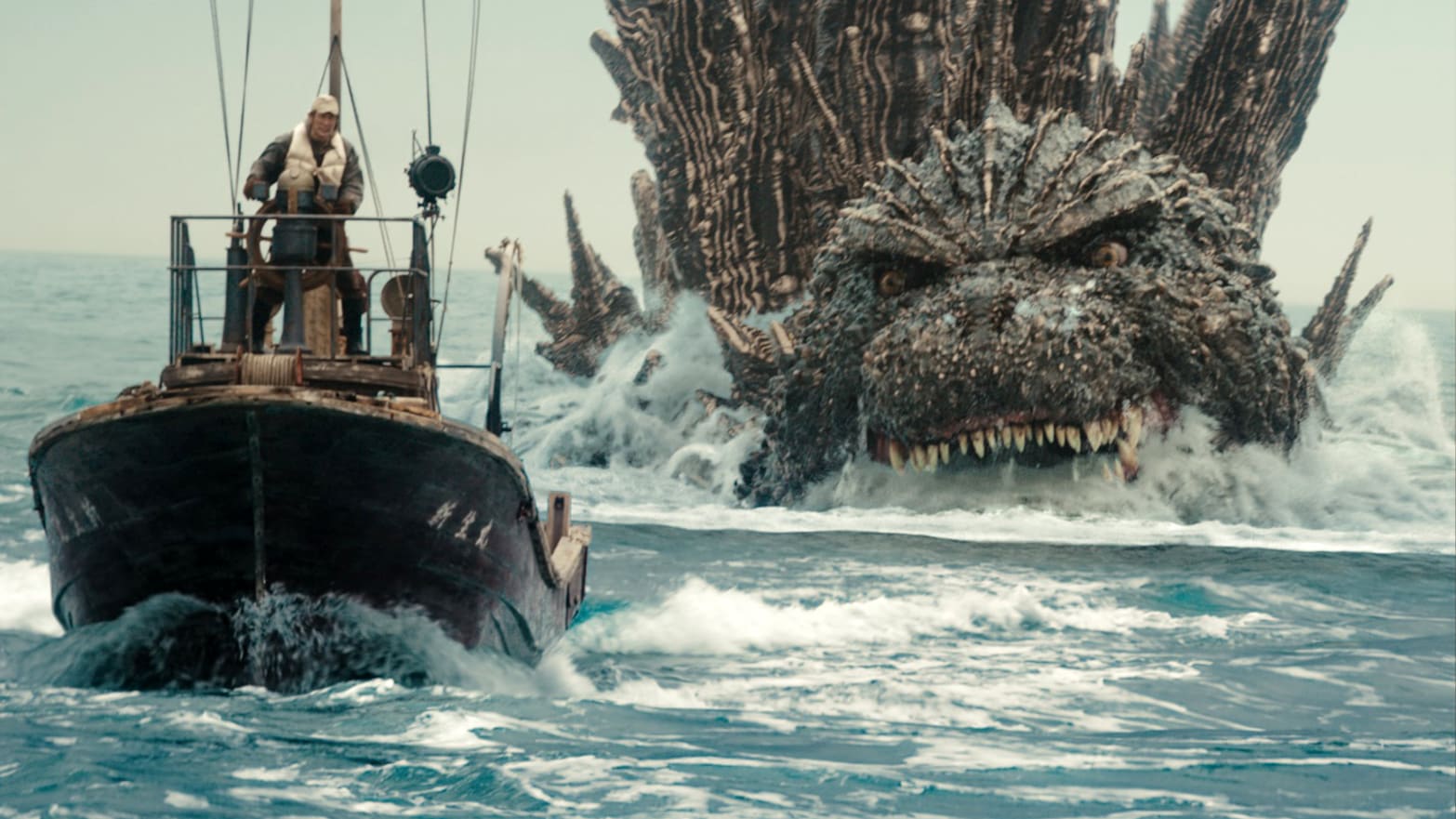
For Godzilla Minus One, Toho’s latest incarnation of their prize property, the G-man has been taken back to his roots, further back than even the original Gojira (give or take the time-travel shenanigans of 1991’s Godzilla vs. King Ghidorah). The story opens in 1945 at the tail end of World War II, and introduces us to kamikaze pilot Kōichi Shikishima (Ryunosuke Kamiki), who is unable to commit to his mandated suicide mission and lands his plane on an Odo Island mechanic station under the false pretense of needing repairs.
Before he has time to reflect on the shame of abandoning his post, the island is attacked by a young Godzilla, surprisingly short in stature compared to what audiences are used to. Despite being only slightly bigger than your average T-Rex, the creature is still more than fearsome enough to wipe out the vast majority of the island’s inhabitants. Given the chance to fight back, Kōichi freezes up, leaving him with a severe double-dose of survivor’s guilt that is further compounded when he returns home to discover his parents dead and his home demolished following the U.S. bombing of Tokyo.
Initially berated for his cowardice by fellow survivor Tachibana (Munetaka Aoki) and neighbor Sumiko (Sakura Ando), Kōichi soon finds himself in the same boat as the civilians around him, forced to put the pieces together and find a way forward in a city that’s been mostly reduced to rubble. To this end, he finds a reason to keep going in the form of Noriko (Minami Hamabe), a young woman with nowhere to go and an adopted daughter to care for. All orphaned by the bombings, the three form a makeshift family and slowly create something resembling a home.
Though providing for the young Akiko (later played by Sae Nagatani) motivates Kōichi to take a high-risk, high-reward job sweeping for leftover mines off the Japanese coastline, he remains haunted by his perceived failures during the war, as well as the ghosts of those who died as a result of his inaction. His trauma only intensifies when Godzilla reemerges, now at a colossal size that’s more in keeping with his reputation. As the beast charts a highly destructive course towards Tokyo, Kōichi and his colleagues find themselves on the frontlines of a civilian-led plot to destroy Godzilla once and for all.
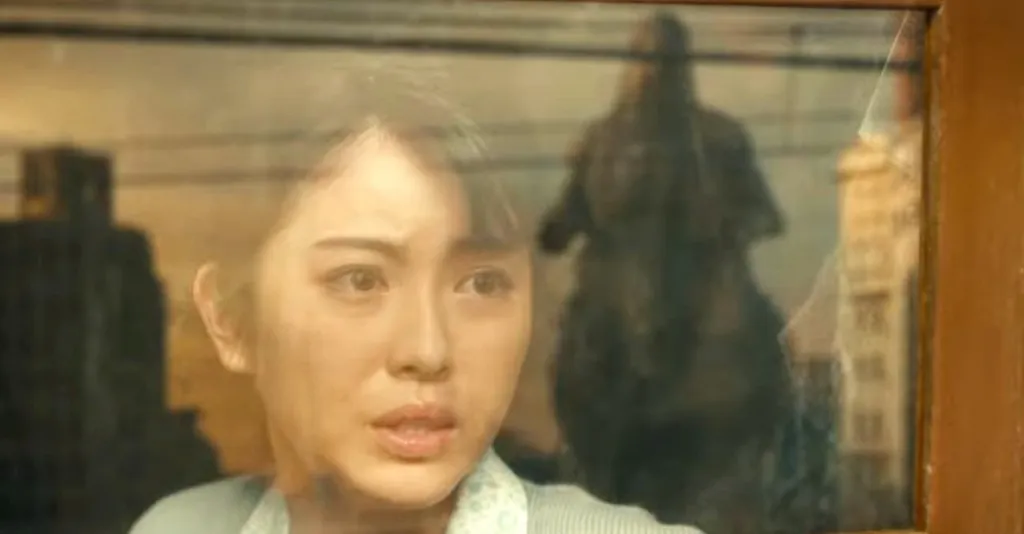
Despite the inordinate amount of time that human characters usually receive in most Godzilla installments (as compared to the main attraction of monster mayhem), it’s often rare for their segments to stand out in any meaningful way. At best, they tend to be representative of various political allegories. At worst, they’re a dull nuisance that can really distract from the good stuff (Legendary’s MonsterVerse entries are particularly bad about this, despite the considerable talent they usually have on board).
This is part of what makes Godzilla Minus One feel like such a breath of fresh air. The human drama is not just fleshed out, but feels both urgent and distinct. There’s real character work here, and a genuine examination of what it’s like for regular people (rather than government officials) to live through back-to-back catastrophes and find a way to carry on. Outside of a brief indication that Godzilla’s newfound size can be credited to American nuclear tests at Bikini Atoll, the film largely moves away from using the creature as a metaphor for the atomic age.
Instead, this version serves as an effective stand-in for the postwar trauma endured by the people of Japan, with the kaiju king feeling less like a character and more like a senseless force of destruction. This ties in perfectly with Kōichi’s desperate search for redemption, as well as feeding into the film’s simple yet powerful message about the importance of survival. The idea of someone making up for past misdeeds through a noble sacrifice is one that is prominent not just in Japan’s history, but in pop culture all over the world (the MCU is a recent franchise that’s especially guilty of pushing this trope). The suggestion that it’s far more courageous to live for your country than to die for it feels like a profound revelation in this context, and leads to a surprisingly rousing and emotional finale.
Though the human elements of the story have been treated with far more care and attention than one might expect from such a film (aided in no small part by an excellent ensemble cast), don’t think for a second that the chaotic spectacle has been underserved. Writer, director, and VFX artist Takashi Yamazaki (whose previous works include the CG-animated Lupin III: The First, the live-action adaptations of Parasyte, and even a Godzilla theme park attraction) clearly comes to the project with a great reverence for the kaiju’s history, as well as his potential impact. This incarnation is as terrifying as he’s ever been, laying waste to cities and naval cruisers in a series of sensationally destructive set pieces.
Whether or not it’s in response to criticisms of the 2014 Godzilla reboot, we frequently get to see the big guy in broad daylight, unobscured by rain or other weather effects that might hide less-than-desirable effects work, and with a satisfying amount of screen time to boot. A Jaws-inspired sea chase between Godzilla and a tiny minesweeping vessel is particularly thrilling, as is a jaw-dropping sequence where the beast tears his way through a nearly defenseless Ginza. The period setting adds to the horror of these scenes, as the people has even fewer resources to combat such an unstoppable entity.
Godzilla Minus One arrives as part of a potential new golden era for the character. Produced in anticipation of his 70th anniversary, it also releases somewhat concurrently with the well-received Monarch: Legacy of Monsters, an Apple TV+ series that digs deeper in the history of the MonsterVerse timeline. In addition, the latest film installment of the same series is slated for release in April 2024, and seems poised to do reasonably well despite the hideously clunky title of Godzilla x Kong: The New Empire.
Fans are going to be eating well for a while, and will no doubt have plenty more to look forward to in the years to come. But no matter how well you know the series, whether this is your first Godzilla film or your 30th, you owe it to yourself to see Godzilla Minus One on the biggest screen possible. The stunning scale of the creature’s rampage pairs beautifully with the intimate scale that sees a group of innately likable characters stand up for themselves and their county in the face of near-total annihilation. It’s a sensational new addition to the legendary monster’s oeuvre, and among the best giant monster movies ever made. In fact, I would even go as far as to say that it’s one of the very best films of 2023.
SCORE: ★★★★


Comments
Loading…