

 Maxance Vincent
The path from musical artist to filmmaker isn’t as hard as some might think, because many of our most celebrated pop artists have a profound knowledge of the art of filmmaking to craft their music videos. I don’t even need to point out any names, but the landscape is vast for you to watch videos that are heavily influenced, or even directly steeped in, film history. Hayley Kiyoko’s Girls Like Girls is one such example, where the song’s lyrics tell a compelling story, while the accompanying music video is highly expressive and features a specific aesthetic that recalls some of the more hopeful coming-of-age films. That song and video turned into a novel, which has now become the movie we are reviewing, already positioning Kiyoko as a multifaceted artist with great penmanship, songwriting, acting, and directing skills. What can’t she do?
Sadly, the film adaptation of Girls Like Girls comes up short, and it’s mostly due to Kiyoko’s choices that betray the incredible, star-making performances of Maya da Costa and Myra Molloy as two girls who fall in love. Costa plays Coley, who is still reeling from her mother’s death and has grown even more distant from her father, Curtis (Zach Braff). It’s in a moment of loneliness that she meets the freewheeling Sonya (Molloy), and sparks almost immediately fly.
The rest of the film follows the burgeoning romance between the two, as teenagers still trying to figure out their messy lives and accept one another. Sonya is in a relationship with the controlling and demeaning Trenton (Levon Hawke) and only feels truly alive when spending time with Coley, who is longing for an actual connection with a human, as her dad spends his days tinkering with antiques in his workshop instead of going through this difficult part of their lives together.
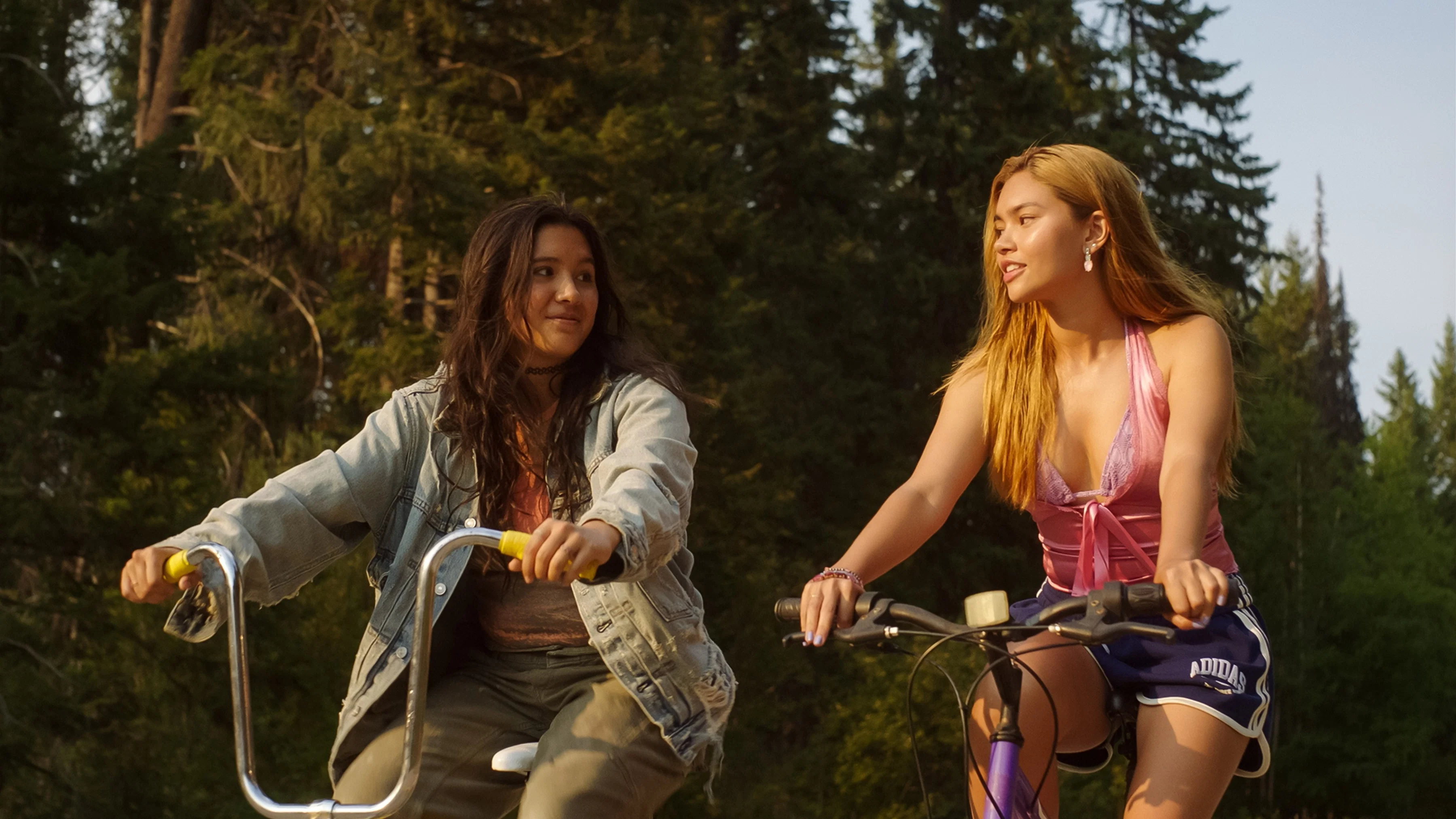
There are interesting thematic threads drawn by Kiyoko and Stefanie Scott’s screenplay (based on a story by Kiyoko and Chloe Okuno), but they’re seldom developed within a story that tracks the same narrative beats as countless other, better queer coming-of-age tales. They were handled with more thoughtfulness than a film that doesn’t really know what it wants to do with its main protagonists and puts them in the same uncertain situations with no tangible texture for what feels like an eternity, but only lasts 95 minutes.
The bulk of the romantic tension between Coley and Sonya is expressed through montages that feel more like rapid time jumps in music videos or TikTok edits than anything with real cinematic power. The film’s visual language, in particular, is baffling and consistently undermines the great work of both Costa and Molloy. Preferring Pinterest moodboards over images that hold actual significance and make us feel the complex emotions of both protagonists, Kiyoko and cinematographer Sonja Tsypin never fully know where to place the camera for an active connection to take place between the audience and the characters.
Kiyoko’s sense of aesthetics might lend well to music videos (the original source material itself is beautifully shot), but that language doesn’t translate well to feature films, especially ones that ask the audience to sit with the protagonist for long periods. The camera should naturally evoke something as it examines Coley’s journey of self-discovery, especially as dramatic events unfold and her relationship with Sonya is (slightly) fractured.
Instead of letting the camera linger in the actors’ faces and letting us observe the character’s broad range of emotions, the movie always strangely cuts away from those introspective moments as soon as possible to move on to the next scene. It’s a film seemingly made for our era, where attention spans have diminished, and we can’t sit for more than a few seconds without a quick distraction.
Many rapid cuts hamper the emotional tension built with Coley and Sonya’s stories, and it’s a shame, because both actors do an incredible job at conveying so many built-in emotions throughout the course of the film’s runtime. Maya da Costa, in particular, is exceptional as Coley and demonstrates a real mastery of emotional modulation that immediately makes the audience feel for her at every turn, as a young girl in search of love amid a sea of grief and loss. While his role is limited, Zach Braff certainly leaves an impression as Coley’s father, especially in the film’s back half, where the two characters begin to confront their unprocessed grief and learn to overcome such a tumultuous period by finally opening up to each other.
When the movie eventually reaches intriguingly constructed emotional territories, without necessarily tying up all of Girls Like Girls’ loose ends, Kiyoko makes the baffling decision to cut to black and to the credits. We know where the story is heading, sure, but you’re left feeling dissatisfied. All of this built-up tension, all of this “will they/won’t they” romance, all of this exploration of Coley’s grief, only for it to end in a Sopranos-esque cut to black? That’s it? Well, not really! If you stuck around until the very end of the credits, you would actually see the film’s real ending! I’m not joking. This isn’t a tacked-on post-credits scene that serves as an “extra” of sorts for the viewers who stayed, but the ending of Girls Like Girls. I won’t spoil it, but the ones who stayed were quite happy with how that scene turned out. I was, too. If only the rest of the movie were as powerful as its post-credits scene.
SCORE: ★★


I completely get that it felt like it ended right when it was getting good