
 Maxance Vincent
This may seem like hyperbole, but I don’t think I’ve ever seen a trilogy that gets retroactively worse with each installment as Renny Harlin’s worthless three-chapter continuation to The Strangers franchise, which started with Bryan Bertino’s 2008 original and was followed up a decade later with Johannes Roberts’ The Strangers: Prey at Night. In fact, there may never be a worse trilogy than what Harlin has visualized on screen with the energy of a washed-up filmmaker well past his prime, who has since lost the passion he might have had while making A Nightmare on Elm Street 4: The Dream Master, Die Hard 2: Die Harder, Cliffhanger, and The Long Kiss Goodnight, and whose heart is clearly not into this one bit.
One even wonders why this was made a trilogy at all, when it clearly has nothing interesting to say and no character to meaningfully develop over the course of three painstakingly dull and pedestrian slashers. The only one who gets a semi-interesting narrative arc over the course of three films is its protagonist, Maya (Madelaine Petsch), who is still trying to escape the clutches of the strangers after the death of Shelly (Ema Horvath) in the second chapter. Instead of finding ways to escape, Maya believes that her best way out is to eliminate the remaining killers, starting with Gregory (Gabriel Basso), who attempts to lure her into his cult of assailants who stalk and kill random bystanders just for the thrill of it. The interrogation mark is there because motivations are being created for antagonists who shouldn’t have any!
While I wasn’t a fan of Bertino’s The Strangers, I can recognize a few elements that gave the film some appeal among audiences. Specifically, what’s most frightening about it is how the filmmaker does not give the satisfaction of a backstory for the antagonists and instead explains that the protagonists were taunted – and ultimately killed – simply because they were there. Removing the random nature of the killings – and showing the faces behind the masks, replete with endless flashbacks that attempt to give texture to these inhumane individuals – completely misunderstands why Bertino’s film and Roberts’ sequel got a cult following in the wake of their respective releases. The aspects that worked were shrouded in ambiguity and did not need an ounce of backstory. The characters were sadly at the wrong place, at the wrong time, and were killed by people who preyed on them only because they found themselves near the strangers’ clutches. If it were anyone else, they would’ve suffered the same fate.
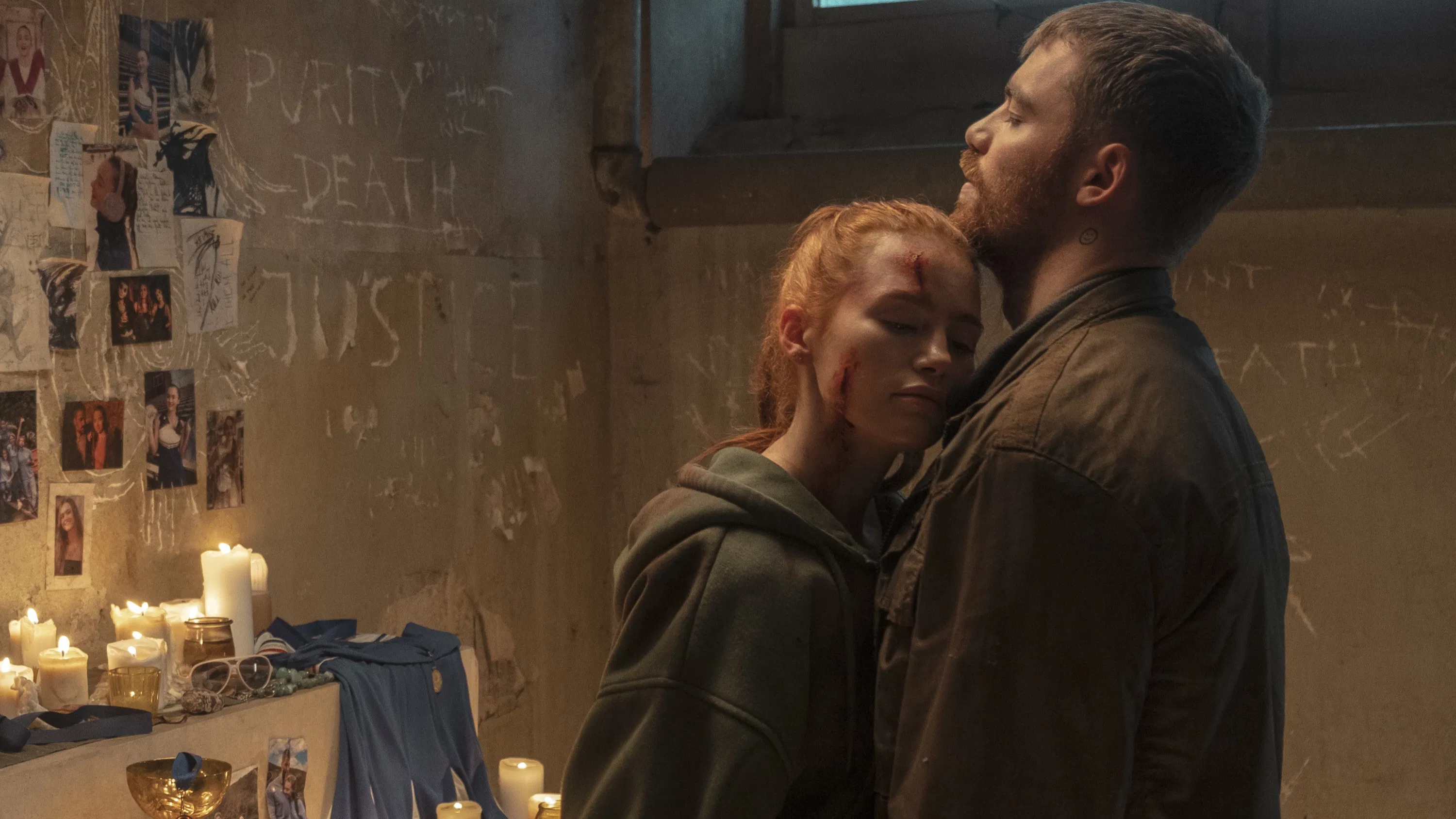
In The Strangers: Chapter 3, Harlin and screenwriters Alan R. Cohen and Alan Freedland expand upon the backstory of Shelly and Gregory, when they were teenagers, and the relationship they have with the town’s sheriff, Howard Rotter (Richard Brake). It was fairly easy to figure out that the sheriff is corrupt and has ulterior motives, but what these specific motives are will put you in a state of total disbelief, because they somehow worsen the (thinly-written) emotional progression of the first two chapters. It also retcons the primary reason that made The Strangers a cautionary tale, thereby removing any sense of tension (or terror) that it otherwise would’ve if it had stuck to the formula that made the first two films outside of this trilogy work for some audience members who found Bertino’s approach to terror raw and emotionally urgent.
In contrast, Harlin’s trilogy lacks any sense of urgency – and purpose – even if Chapter 3 attempts to add tangible stakes by having Maya’s sister, Debbie (Rachel Shenton), drive into town to find her whereabouts. You can probably guess that she – and her entire crew – get quickly dispatched in a succession of killings that are as haphazardly directed as the last, with no real verve or shock value behind them. They’re all shot with little to no passion (Harlin has clearly given up on the craft of genre filmmaking if we’re to compare this with his most-known projects), there’s no tangible message to hold onto, or characters that are worth your investment in a film that has no idea what to say about any of them, or the nature of violence at the heart of their perceived evil.
Only Maya has something that resembles an arc, but even Petsch’s performance can’t overcome the screenwriting inconsistencies that her character suffers, trudging through a bland open-ended conclusion that doesn’t act as a cliffhanger, but as the final nail in the coffin for this otherwise worthless trilogy. Basso and Horvath are both excellent actors, but no one could’ve given something of note with the shoddy material they’re working with, which allows them no room to play or even bring their own sensibilities into characters that are essentially one-note attributes.

You would think that after two painfully terrible films, Harlin would have the energy to bring it all home with The Strangers: Chapter 3 and give audiences something, anything, to at least examine. The thing is, these films offer nothing to the viewer other than a pure waste of the precious time we have on this planet. Harlin doesn’t seem at all interested in doing something aesthetically compelling or thematically resonant, even during sequences where religious imagery is allegedly flipped to its head. Allegedly, because Harlin never delves deep into anything he presents (just like in the unwatchableExorcist: The Beginning), and has the audacity to offer a trilogy of films where nothing of legitimate consequence happens and paper-thin characters barely evolve??
At least The Strangers: Chapter 2 had an insane action setpiece with a CGI Boar that came out of nowhere and brought about the biggest unintentional laughter I’ve ever heard at a press screening. Chapter 3 is a boring excuse of a “film” with zero redeeming qualities, whether intentionally or unintentionally. No, wait, there is one positive thing to say about the film, and it could be the year’s biggest glimmer of hope yet: it’s over. There will be no more Strangers entries from this “franchise.” Thank God for that.
SCORE: 1/2★


Comments
Loading…