
 Cory Stillman
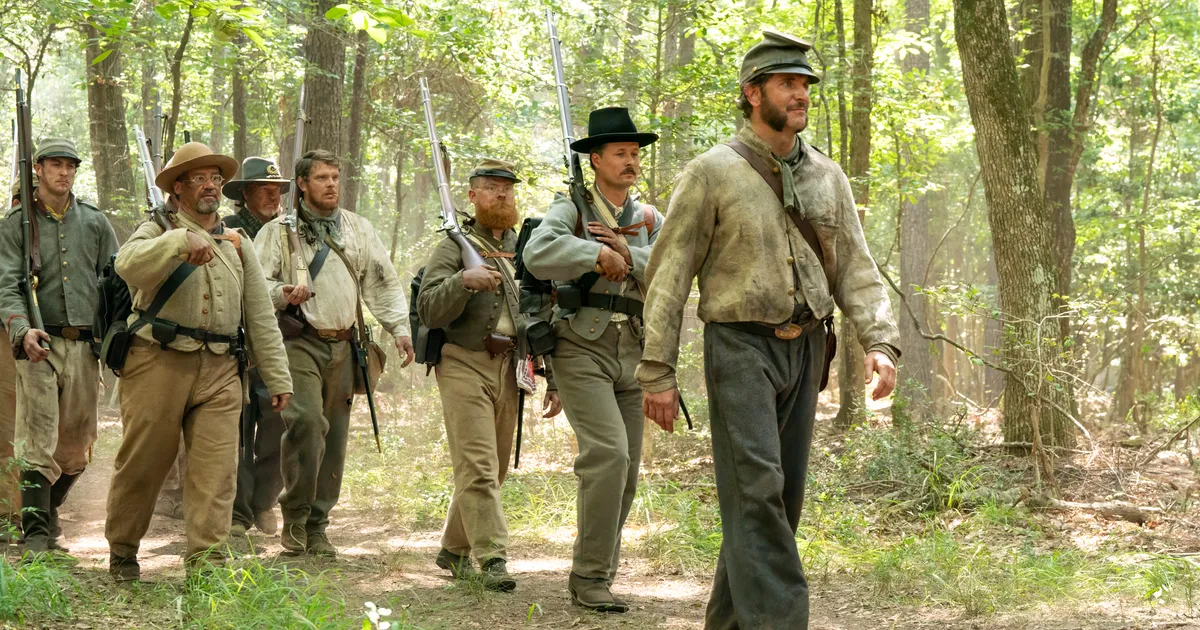
S4E1 of The Righteous Gemstones is perhaps the most surprising episode of the entire series. “Prelude” travels back to the Civil War era to introduce us to Elijah Gemstone (Bradley Cooper), whose sins cast a centuries-long shadow over the Gemstones we have come to know and love (and maybe even hate) today.
The episode is uniquely cinematic, due in large part to the soundscape crafted by music editor Michael Brake and supervising sound editor Nicholas Renbeck, both of whom are Emmy-nominated for their work on the beloved HBO comedy series.
“I felt I was able to look and hear this show again as if it was something brand new, which was really exciting,” says Renbeck of the Civil War episode. “I don’t think I can say I’ve experienced that with any multi-episode, multi-year project I’ve worked on before.”
“Prelude” is a legitimately immersive rendering of a historical period that is not depicted onscreen as often as one may think. It stands amongst the better depictions of the Civil War in recent memory, and as Brake points out, that is due in large part to the entire team’s attention to detail.
“It might seem small, but when the Civil War marching band drummer plays a bit out of time or hits a wrong note, I want to hear it,” says Brake. “Even if it’s only a couple seconds of a tracking shot and there’s a whole lot of other stuff to look at.”
As the creative duo points out, the episode presented a unique challenge from the rest of The Righteous Gemstones, as the time period immediately stripped the sound team of the kinds of technologies and sources that tend to define a modern-day soundscape.
“Our sound palette of 1862 is a much narrower one than current day,” notes Renbeck. “We are looking back in time with no cars, planes, or electronics…. that to me meant more bugs, more birds, more horses, more nature, a more forward roll for foley in the soundtrack, and a lot more specific loop group voices for the background actors.”


Check out our full conversation with Michael Brake and Nicholas Renbeck below. The guys share their favorite scenes from their entire time working on The Righteous Gemstones, including a few iconic musical moments.
Hey Nicholas and Michael! After working on all four seasons of The Righteous Gemstones, how have you seen the show evolve over the course of its run?
Michael Brake: For me personally, my favorite jump that the Gemstones made from the other original Rough House series on HBO is the inclusion of original songs – of course the music editor would say that. We didn’t do anything like this level of original songs in Eastbound & Down or Vice Principals. Season one’s “Misbehavin’” came bustin’ out of the gate. Casting Jennifer Nettles as Aimee-Leigh Gemstone is one of the great gets in Hollywood history for me, maybe only second to Walton Goggins as her brother, Baby Billy Freeman. The producers allowed our composer, Joey Stephens, an outlet for his immense songwriting talent. And I feel over the course of the four seasons of Gemstones, the comfortability of adding new original songs in smaller places to really fill out the Gemstone world made such a richer experience (and more fun job) for me. Mike Mitschele and Rick Randall wrote a lot of the in-show themes (“Bible Bonkers,” “Teenjus,” “Prism,” lots of stuff in the Gemstones church) and they are again just incredible earworms. I feel like each season, we got deeper and deeper into a richer musical world of the Gemstones.
Nicholas Renbeck: For a show that’s billed as a 30 minute comedy, its definitely pushing the boundaries of that definition. Danny has referred to some episodes as mini features which I wouldn’t argue with. Compared to other 30 minute comedies I’ve worked on, this show proves to be incredibly ambitious in what it puts on the screen. And for the post sound and music departments, we’ve had to keep pace with it.
We started way back in season one with a wave pool mass baptism that goes horribly wrong, and then the show just kept building from there. Always going in so many different directions; lots of live musical numbers, numerous car chases (often ending with a huge crash), motorcycle jousting, monster trucks, clogging dance numbers, Kelvin’s God Squad of bodybuilders with their ritualistic feats of strength, wrestling matches, plenty of gun fights and explosions… that list is far from complete. From a sound editing and creation point of view, it kept every season fresh and exciting.
At the end of season three it felt like Danny and Rough House were pulling out all the stops when the swarm of locus bursts into Baby Billy’s ‘Bible Bonkers’ TV show. The amount of VFX shots in that episode that needed to be paired with original sound work was at a level that I had not really seen before in a “TV comedy.” Combine that with the fact that Danny and his team are creating a show that’s so funny, smart, and irreverent, while at the same time having a lot of heart, made the whole series incredibly enjoyable.
Then this season’s opening episode switches it up again with a prequel story of an early Gemstone family member during the Civil War. It took the show in an entirely different direction, with a more serious cinematic look and tone.
What are the key creative considerations when mixing and editing the sound for such a funny show like The Righteous Gemstones?
MB: Yeah, it’s something we actively don’t do that’s more fun and interesting to me. We don’t play the comedy. We score the drama and tensions. In temp scoring the episode before lock, the editors and I stay very neutral with the music. This cast needs nothing musical to add to the comedy. Coming from a varied comedic background, I sometimes have to remind myself not to play a joke with music.
NR: I think our sound team has always viewed our rolls first and foremost as to support the story that is being told. But in that supporting role there is a lot of freedom in building the sounds of these locations and things the Gemstones live and interact with. I’ve worked on other shows where, the sound of the world isn’t afforded much importance to the story. Danny has been opened to hearing the world around his characters and encouraged finding ways to help sonically direct and focus the attention of the viewer.
Much like Michael notes with the music, with our sound work we are not trying to be the funny aspect of the show. That’s never sound’s main job for Gemstones. There are definitely moments where some elements of the sound is supporting the humor on the screen (and might be a funny sound), but most of the time we are looking to give you clean understandable dialogue tracks (to hear the funny), and then build a dynamic sounding world where we can selectively play with those sonic elements to help focus the viewer’s attention to where the story needs it to go.
Thankfully I’ve had a fantastic sound crew who brought their A-game every single episode. Martin Czembor (Re-Recording Mixer), Alexa Zimmerman (Dialogue Editor), and Deborah Wallach (Supervising ADR Editor) have been with me all four seasons. Rachel Wardell (Sound Effects Editor), Ailin Gong (Foley Editor), and Tommy Stang (Foley Artist) each joined the team respectively during seasons two, three, and four.
We’ve worked hard at finding the right balance of what we are creating with sound, and how it is played in conjunction to the music tracks that Michael is bringing to the mixing stage. I’ve come to view Joey Stephens’ score as a gift we get to situate our sound work beside. Each element supports and lifts up the other.
Is there a particular episode or moment in S4 that you are particularly proud of from a sound perspective?
MB: I think all the sound and music editors out there might relate to this – it’s the tiny details that make it feel real that I’m proudest of. The Civil War marching band, the band playing around the campfire in Episode 401 “Prelude” (which we’re Emmy-nominated for), weren’t perfect when I first saw them. I spent some time replacing and editing tracks to make sure those scenes felt as live and real as possible. It might seem small, but when the Civil War marching band drummer plays a bit out of time or hits a wrong note, I want to hear it, even if it’s only a couple seconds of a tracking shot and there’s a whole lot of other stuff to look at. I want to hear exactly what we see, so I re-edited the pre-recorded drum stem to match… locators on every snare hit. Reality is built on the smallest of details. It’s the same with the Cape & Pistol bagpipe and drum corps for the duel in Episode 409… and the moment when John and Danny are clapping to “Little Angels, Big Hearts” in 409, and on-camera they clap a flam where there was nothing in the pre-record or guide track there… I need to hear it. Even the songs of Aimee-Leigh and Lori tracking in the studio, there are a few fun edits that make it clean and real. I love finding the details and making them real.
NR: I think S4E1 “Prelude” is one we all took a lot of time and care with. It’s such a departure from every episode that has come before, and yet totally a Gemstones story. Through this episode, set in the Civil War, I felt I was able to look and hear this show again as if it was something brand new, which was really exciting. I don’t think I can say I’ve experienced that with any multi-episode, multi-year project I’ve worked on before. Production value from the set was definitely stepped up on this one. Our head picture editor and co-producer Justin Bourret called me a few months before I was scheduled to start on the season to tell me Danny wanted this episode to sound a bit bigger, a bit grander, “more cinematic.” He then sent me the two main battle scenes for some early sound work building out the war sounds.
Thankfully “more cinematic” was marching orders Danny gave to all the departments, and I think everyone really delivered. What Paul Daley (the DP) and Danny chose to shoot, and then how Justin structured the picture editing of the story gave the entire sound team the opportunity to capitalize on the ideas of pacing and proximity. Specifically to find moments to place more subtle quiet sounds, and then contrast those elements with the larger battle scenes, or full music moments. All of this allowed us to create a more dynamic and varied soundtrack.
S4E1 is an impressive departure from the show’s traditional storytelling. Can you tell us more about crafting the soundscape for the episode’s Civil War-era setting?
NR: I would say we were able to create a lot of subtle rich backgrounds for this episode. Again I think the reason we could do that as well as we did, hinges on the choices that were made in the writing, directing, shooting, and editing. And they were all great choices for us in the sound department.
This episode, while having plenty of dialogue, still manages to have numerous moments where no one is talking. Or if they are talking, the pacing of the conversation allowed for the sounds of 1862 to sneak in and fill out the audio mix without stepping on the dialogue. Those are all rich possibilities for us to exploit sonically, and we actively look for those opportunities.
Our sound palette of 1862 is a much narrower one than current day. We are looking back in time with no cars, planes, or electronics…. that to me meant more bugs, more birds, more horses, more nature, a more forward roll for foley in the soundtrack, and a lot more specific loop group voices for the background actors. So outside of the battle scenes, that was my sonic sandbox to play in. While that might seem to be limiting in what you could create in reality is turned out to be quite the opposite. Specific bird songs, woodpeckers knocking at trees, crickets, cicadas, horse vocals, wind through forest trees, all those sounds begin to expand when given time and space to live in the soundtrack.
People are always saying turn off your phone, don’t talk, go outside and walk around in nature. And what you hear can be pretty amazing, with so much detail and variation. I found the same thing to be true even with recordings of nature. I think all those type of sounds hit something deep in our core being as humans. So we tried to tap into that when the story lead us in that way. And then when we hit the battle scenes they could feel extra large and exciting.
Having also worked on HBO’s hit series Succession, can you compare your creative approach to these two projects?
NR: I think the biggest difference between Gemstones and Succession for sound was the idea of wealth and how it was represented.
For Succession, wealth was shown by silence. My first spotting session on that show with Adam McKay (director of pilot / executive producer) said the Roys are so rich that they can afford silence in New York City. So while in a Roy’s apartment or the board room where they worked the outside world of the street never intrudes. (Their apartment windows are triple paned I guess). When they go away on vacation outside of the city those locations are pristine and serene. It was only when they were leaving their apartments to get into their cars on the street of New York that we could play with some more intrusive noise, as they weren’t totally in control in those locations. Even the helicopters sounded muted and a bit zen.
For Gemstones, it’s kind of the opposite. We play up the sounds of all their toys. Their wealth brings church rock concerts in the salvation center, muscle cars, and speed boats….all the loudness money can buy. When creating the sounds for a given location in Gemstones I was always looking for elements to make the location more detailed and diverse. For Succession I was looking to strip detail away a lot of the time.
S4 also features a few hilarious hilarious musical moments. What was it like designing the sound for these moments, and who were your key collaborators for these scenes?
MB: I know this is mainly a question about soundscape, but a huge shout-out to our music supervisors DeVoe Yates and Gabe Hilfer (also Emmy-nominated for this season). Besides the incredible original songs, we were up to the same level of hijinks with licensed music as previous seasons. All of the Rough House series have had some of the most varied soundtracks on television, and that is DeVoe – he is just outstanding. What other music editor out there has had the joy of auditioning edits for Tim Baltz expertly performing a pole dancing routine or Walton Goggins waterskiing in a birthday suit?
NR: Well we are going to have to go with the Jet Packs in the big Salvations Center Telethon sequence in episode 402. Danny wanted to know before we hit the mixing stage what these devices were going to sound like, and honestly I don’t think any of us had a great idea of what that sound should be as we first started discussing it. Rachel Wardell (SFX editor) and myself searched the internet for any video we could find of actual jet pack sounds. Unfortunately a lot of them just sound like really big loud hair dryers, which sonically wasn’t very interesting. So we just started throwing things together to see what would stick.
I don’t remember all the elements at this point but I think part of the sound is an industrial air compressor, a jet engine afterburners, some beeping or the lights in the back, maybe a nasa type radio beep for when they are first taking off. I think powering up and down of a few electric devices, and then the sputter of an old jalopy engine for when it gets out of control.
Once you pair that with the crazy action on the screen, and the yells and cheers of the crowd and the entire musical number, yeah I think that worked alright.
How does your approach differ when crafting sound for the “show-within-a-show” moments, like Teenjus or Baby Billy’s Bible Bonkers?
NR: I think I hit it the same way as I do all the other scenes.
Thanks for joining us! Are there any other genres or formats in which you would like to work? Do you have any upcoming projects you may tease for us?
MB: Fun question! I love the work I’ve done, but I’ve had a chance to work on some horror projects as well and musically they are so fun! I hope to do more of that. I also have done a good bit of work in documentaries recently, and It’s Never Over, Jeff Buckley just hit theaters this month (Aug 2025). That was an EXTENSIVE amount of work, even before getting into the editorial. Amy Berg had been making this for 15 years… and you can feel her love and passion for it. It’s an incredible telling of one of our best musicians ever.
NR: Fun question indeed. I feel extremely fortunate with all the recent opportunities I’ve had working on some great TV series with some extremely talented people. In a perfect world I’d get the opportunity to continue to work with as many of them as I can again.
I’ve spent much of the last 8 years working on TV series, but I started out in features and documentaries. It would be great to step back into those worlds from time to time for the right projects. I think it would be a blast to do the sound design and mixing for a scripted podcast. I’ve been streaming Dolby Atmos music mixes (7.1.4) over Apple Music in my studio. Some of these Atmos versions are extremely fun to listen to. I would love to know more about that world of mixing. Recently finished supervising/re-recording mixing an 8 part series for Peacock, Devil in Disguise: John Wayne Gacy by showrunner/creator Patrick Macmanus.
Stream all four seasons of ‘The Righteous Gemstones’ on HBO Max to check out more of Michael and Nicholas’ work.


Comments
Loading…