
 Jeff Heller
As The Boys heads into its final season, Erin Moriarty is taking time to reflect on her character’s journey. As Annie January, known to the masses as Starlight, Moriarty has portrayed one of the show’s few morally grounded characters. But in Season Four, Annie faced some of her biggest challenges yet—losing her powers, questioning her identity, and going up against a dangerous shapeshifter version of herself.
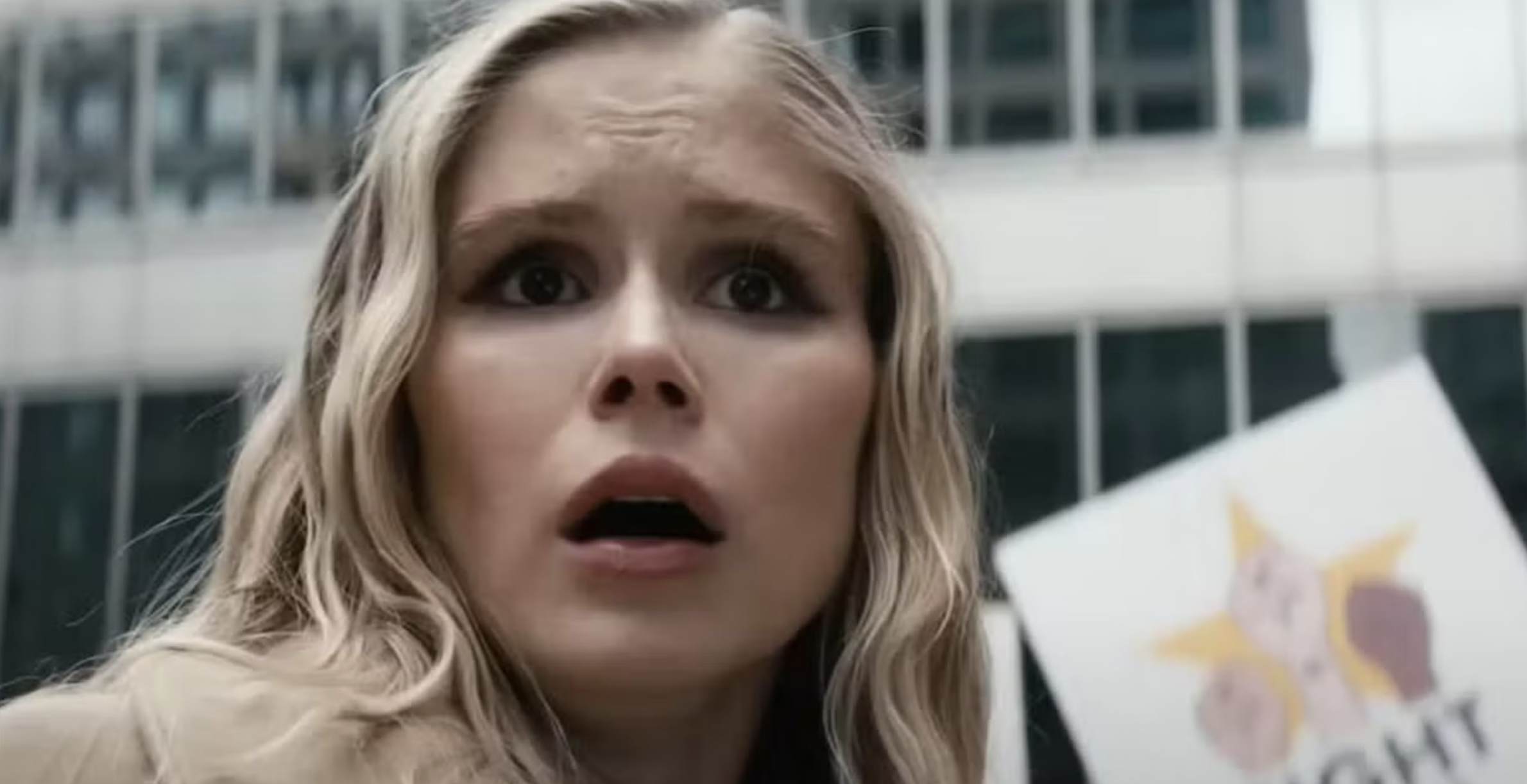
We talked with Moriarty about how she prepared for those demanding scenes, what it was like to switch between two very different characters, and how her connection to Annie has changed over the years. She also discusses the emotional complexity of the role, the physical demands of the shapeshifter fight scene, and why playing a sociopath was unexpectedly fun.
(You can watch or read the interview in its entirety, below)
How are you doing?
I’m really good. I’m sort of in the craze of finishing up our series finale, so it’s this ephemeral moment in time where I’m just soaking it up, working these long days, but never been more sort of nostalgic for what’s still transpiring in front of me.
You obviously can’t talk about season five at all, but I’m curious if Annie’s overall character arc is what you expected it would be going into this series, to begin with.
You know, it’s not, but in ways that continuously delight me. First and foremost, because this comes to mind because it was more recent, the shapeshifter component was completely and totally a surprise. I usually get notified via our showrunner, Eric Kripke, about certain storylines and certain significant plot points in advance so that I’m aware of them so I can start preparing. But that scared me so much because I wasn’t sure if I would be able to do it in a way that I really needed to for myself and to do that storyline justice.
It was so challenging, but even when I booked the part, the script that I received was not the script that we ended up shooting. True to his nature, Kripke called me up and said, “Just so you’re aware, I’m going to include a storyline that, if it’s okay with you, entails something that mirrors the MeToo issue going on in the real world.” So that wasn’t a part of the script that I auditioned for. That to me was symbolic of what we were about to take on together with this character. Someone who was iconoclastic and someone who was going to break every box that you put her into. So, she’s been surprising, but not arbitrarily so. She’s been surprising in these really pleasant ways that I just feel fortunate enough to be able to play, and that feel emotionally justified.
Where do you think Annie stands morally at the end of season four?
She is a moral character. We can both externally observe her and say that she is one of maybe two or three or four characters that are actually good in a very gray show. But generally speaking, if there’s a bad and there’s a good side, the mandatory precursor is knowing who you are and having a firm sense of identity. And her season four is literally and metaphorically losing that. She loses her powers. She loses who she is, and she sees herself quite literally as a reflective piece in the shapeshifter. And so, she finds who she is. And that is what we learned to be the essential precursor to showing up for situations that call for her morals. So, the question is, is she able to hang on to that for season five? As we’ve discussed, there are many surprises and there are no linear trajectories with these characters. And that’s what I love about it. It’s this show that entails superheroes that’s ultimately so human and so anti-formula and so centered around the human condition and what it is to grasp morals and, conditioning and or lack thereof in terms of morals. It’s about identity and it’s about whether or not she’s able to hang on to what she needs to accomplish her goals.
I spoke with you and the cast a few years ago during season three, and we discussed the duality of portraying Annie and Starlight. But have you approached the character differently since that duality is really no longer relevant?
I have. I think that the lack of duality had her really confront some issues that she was going through because I think a lot of us, myself included, thought when she left the Seven, there was this opportunity for her to explore who she is, and there would be some sort of sense of arrival. But like life, there is no sense of arrival, and it’s not that neat. And then she’s confronted with this concept, “Oh, maybe when I’m out of the seven and I’ve been blaming a lot of my lack of identity on being in the Seven and not knowing how to find myself, that actually my lack of identity lies in my inability to confront certain components of myself that might contradict who I am,” which we all do.
I think at a certain point, because once again, the human condition is a messy condition to live in, that duality is then confronted in sort of emerging of dualities and in a much more nuanced way. The darkness, lightness within her, and she has to accept, “Okay, the point is I am not defined by my worst actions. I am defined by what I try and presently and earnestly do in each circumstance, micro or macro that I enter myself into, whether it’s a room with Firecracker or it’s taken down Homelander. My intention is to leave every situation better than how I first encountered it.”
You mentioned the shapeshifter. Did you tackle that as if you were portraying a different character?
I did—100%. But there was an added dimension to it. When I show up to set, there are a lot of sensory triggers that make me feel like Annie. I’d see our camera operator Liam, for example, and just instantly feel like I was stepping into Annie’s shoes—on a set I’ve been on since I was 23. That familiarity, the subconscious cues, and even Annie’s physical mannerisms are all part of how I slip into character.
So, I had to consciously shake that off for the shapeshifter. I actually videotaped myself moving around my house and watched it in fast-forward. It was humbling. I even saw glimpses of my mother in my movements. During the fight scene, I was flipping between characters constantly. It wasn’t like six hours as Annie and six as the shapeshifter—it was switching back and forth constantly.
To reset, I needed something strong. I tried perfume (I usually pick one per character), but it wasn’t enough. Then I heard a podcast with weightlifters who used smelling salts. I bought some legally while filming in Canada, and they became my trigger to transform into the shapeshifter. I wouldn’t recommend them—they hurt! But they shocked me out of Annie mode and helped ease my anxiety.
Did you have different choreography for each character during the fight?
Yes, very specific choreography. With the help of our amazing stunt coordinator, John Koyama, we designed distinct movements for the shapeshifter—sharper, more animalistic, even reptilian. I used elements from the Alexander technique to build physicality. The shapeshifter moved her neck and made eye contact in jarring ways. There’s even a moment in the fight where I—well, the shapeshifter—bites a man’s neck and spits it out.
These small, primal moments really helped me flip into the shapeshifter. It was all in the details—turning my head a certain way or adjusting my eye contact to feel more threatening but natural. That physicality made it incredibly fun. I definitely want to play another psycho killer—it was more enjoyable than I expected.
Annie ultimately takes the shapeshifter’s life—supposedly. There are rumors online that the shape-shifter is still alive. Do you think that was a turning point for her?
Absolutely. Annie had to face parts of herself she had avoided. She didn’t use the Seven as an escape, but the constant chaos made it easy to ignore her internal struggles. When that chaos died down, those hidden parts of her surfaced. Firecracker’s confrontation only intensified that, forcing Annie to reconcile with her past.
So, when she kills the shapeshifter—supposedly—it’s clearly a metaphor. Annie feels like the public is constantly tearing her apart, and that affects her identity. She’s trying to move from being extrinsically motivated to intrinsically motivated. And because it’s a TV show, that personal growth has to happen in this batshit, accelerated way.
It’s a hyperreal version of something we all experience. To become full people, we have to acknowledge our dark and shameful sides. Only then can we move through the world with less self-doubt. That’s what Annie is doing—on a highly dramatized scale.

You were given a lot more to play with this past season on an emotional level. Can you just talk about digging a little deeper into Annie?
It was really exciting to explore Annie’s darker side. I didn’t want the emotional beats to rely on crying. There’s this misconception that crying equals good acting. Instead, I aimed for suppressed emotion—something that feels like it’s simmering under the surface. That gave her a new texture.
As for the shapeshifter, she’s schadenfreude incarnate—someone who revels in inflicting pain. Her sensuality, her manipulation, especially with Huey, came from a dark, cathartic place. Every body she inhabited was a chance to validate her twisted theories about humanity being corrupt and contradictory. It was an emotional spectrum—and a brand-new toolbox I got to play with. It was really fun.
Would you say your connection to Annie has evolved over time?
Definitely. I’ve grown up alongside her. When I first auditioned for The Boys, I was about the same age Annie was meant to be. My first audition was actually her scene introducing herself to the Seven. As she rose to fame, uncomfortably and reluctantly, I was experiencing my own version of that—though mine was far more privileged and enjoyable. Still, that parallel added depth. The more human experiences I’ve had, the more I can infuse into Annie. It’s been cathartic, and I’m grateful.
Were there any scenes this season you’re particularly proud of—emotionally or physically?
Definitely the shapeshifter fight. It’s the hardest I’ve ever worked. I was terrified, the stakes felt enormous, and I was constantly anxious. I honestly barely remember filming it—it required total immersion. I didn’t really enjoy it while it was happening, but the antidote to the anxiety was hard work—being present, prepping, rehearsing. And working with Eric Kripke on that arc was incredibly rewarding. We were both fully invested in making it work.
I still refer to that scene as a two-person scene, even though it’s just me. I didn’t know if I could pull it off, so seeing it come together—knowing Kripke was satisfied—that’s one of the most gratifying experiences I’ve ever had. I remember visceral moments of it: the hard work, the presence, the joy of playing that sociopath. It was wild, but so much fun.
Well, I know you’re busy. I’ll let you go. Thanks for your time—and good luck with Season Five.
Thank you so much, Jeff. I really appreciate it.
The Boys is currently streaming on Prime Video.


Comments
Loading…