

 Robert Hamer
You know about death, that it’s just a change, not an end.
Twin Peaks was, and is, a show invincible to the ruinous clickbait analysis of modern internet explainers and “Plot Breakdown” dorks who want to gaslight us into believing stories are puzzles meant to be solved. But that was what made David Lynch such an extraordinary artist. He was a dreamer, perhaps as close to a literal one as any filmmaker of his generation. What is BOB, really? What did Sarah Palmer know about her family, and when did she come to know it? What exactly happened to Audrey? Does the town even exist in the “real world?”
Anyone who had hoped to have those questions definitively answered in Lynch’s final project Twin Peaks: The Return were destined for disappointment. To seek a concrete answer that David Lynch just spoon-feeds you, like the second half of a Ted-Ed riddle video, is to demand something you’ll never get at the expense of answers more… emotionally true. More profound. Like the feelings you have after waking up from a lucid dream.
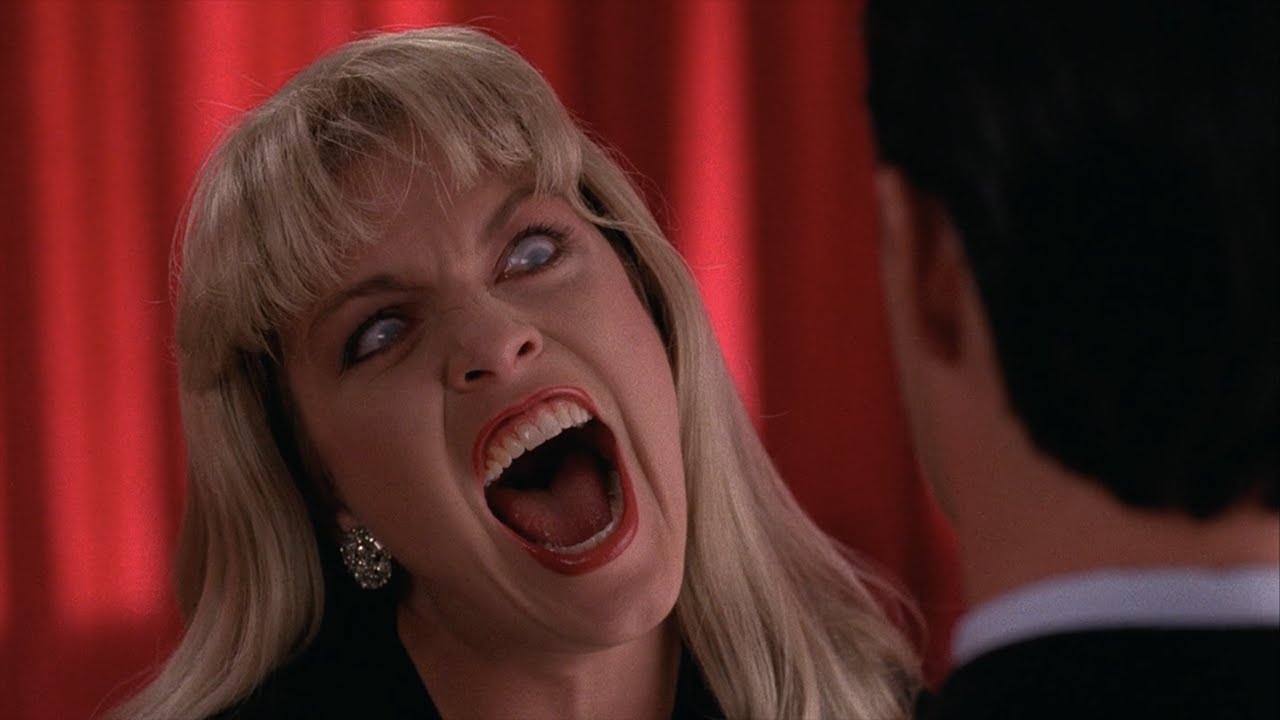
There’s some fear, some fear in letting go.
Like dreams, Lynch’s visions swerve from silly to frightening to poignant on a dime. They feel like they’re observing something true even if you can’t quite articulate what that truth is. The images and sounds you experience in a dream re-stage what you’ve seen and heard before in ways that are… off. They disturb and unsettle you. Then you wake up to a reality full of unknowns and anxieties somehow inverted from how you perceived them in your “nightmares.” Much like how the first two seasons of Twin Peaks were a funhouse-mirror reflection of 80s soap operas and Twin Peaks: Fire Walk with Me was a dark subversion of the tropes of 90s crime thrillers, Twin Peaks: The Return concluded David Lynch and Mark Frost’s suburban chronicle of murder and lies through a merciless deconstruction of prestige dramas that reigned supreme during the Golden Age of Television.
Or how dreams mutate and distort our own id. The “truth” of Diane’s dreams in Mulholland Dr. is that she lost the love of her life to a powerful man offering Hollywood fame and fortune. There was no pressure from sinister forces to cast “Rita.” There was no murder mystery; the lethal threat always came from her jealousy and shattered aspirations. Dreams of the glitz of showbusiness being twisted into a reflection of how our collective delusions of Hollywood glamor acting to shield us from its ugliness, exploitation, and self-righteous hypocrisy. Why, yes, I am also drawing a connection to INLAND EMPIRE, his final feature film.

Diane is a jealous and vindictive woman, but also… not just those things. We are so much more than the worst thing we have done or will ever do. We contain multitudes in the real world, and wrestle with that uncomfortable reality in our dreams. How much more comforting would it be for us to easily slot our interactions into easy-to-comprehend categories?
The wind is moaning. I’m dying.
In Lost Highway, Fred… or is it… Peter? imagines a Mystery Man driving him into an odyssey of murder. In INLAND EMPIRE, Nikki… or maybe… Sue? is terrorized by the Phantom. Dan is so terrified of an ashen figure behind Winkie’s Diner that the mere sight of it causes him to collapse in shock… but does Dan even exist? Or is he just a figment of Diane’s dream? And why would a figment of someone else’s dream be scared of some other dream apparition?
Because, to Lynch, what we imagine can be as real and valid as the real world. How we dream, feel, fear, and picture the world through the stories we make up and different identities that make up our whole selves all inform the tangible lives we live. We can either confront and make peace with that, or we can lose ourselves in delusion, causing tremendous harm to everyone around us in ways that reverberate forever. Even in Lynch’s most straightforward, easy-to-comprehend movie, The Straight Story, Alvin concludes his long journey with lingering pain and regret. He cannot go back and undo his decisions that led to his estrangement from his dying brother. He cannot undo his fatal mistake during the war. What matters is how those feelings help him navigate the world now. Even as an elderly man, who he is has not yet become a foregone conclusion.
The only foregone conclusion is the one dilemma Lynch always confronted, precisely because we can never alleviate it. One day, our dreaming ends. We often die at the hands of others. Sometimes ourselves. But we always end our stories one way. Our imaginations, our dreams, can never pierce through what happens after we die. But maybe that’s okay. Maybe in not knowing what happens to us after we die, we can make peace with other things we try too hard to understand “logically.” Roger Ebert once described a movie as a “machine that generates empathy.” Few filmmakers who ever lived took that idea as an edict, marshalling all the technology at his disposal to reflect our suppressed humanity and complex, unexamined feelings back at us, to force us to confront those less-easily-comprehensible dimensions of ourselves, as profoundly as Lynch did. He combined image and sound in truly unique ways. To unsettle us, yes, but also to place us in spaces that feel so uncanny, but also guide us to something that “feels” true in this bizarre experience called life.
At least, it helps us understand such an experience while it lasts. Because it won’t last forever.

Thank you, David. Thank you for challenging us, taking us to such horrifying and beautiful places like Twin Peaks, and using cinema to show us something far beyond the frame of the screen. You are now gone. The dreams you depicted are not.
Goodnight, Hawk.


Comments
Loading…