

 Danny Jarabek
With a rich legacy of source material stemming from James Clavell’s 1975 novel to the first screen adaptation as a historical drama miniseries in 1980, Shōgun is back with a new adaptation created by Rachel Kondo and Justin Marks. With a primarily Japanese cast and majority dialogue in the Japanese language, it became only the second non-English language series to be nominated for a Primetime Emmy Award for Outstanding Drama Series, accumulating 25 total nominations.
One of those nominations is for Christopher Ross for Outstanding Cinematography for a Series (One Hour) for his work as a DP on the series’ first episode, “Anjin.” Ross discusses the inspiration for the series in depicting an authentic and specific period in Japanese history. In collaboration with the production designer for the series, the show balances shooting between built stage sets and on-location sets, as well as utilizes significant natural lighting. Ross also details the framing work done in the cinematography to reveal more than meets the eye about each character and their potential motivations.
Read our full conversation with cinematographer Christopher Ross for Shōgun below.
Hi, this is Danny Jarabek, here with Awards Radar, and I’m very excited to have with me today Christopher Ross. He is, of course, a DP on the FX series Shōgun, Emmy nominated. Congratulations, Christopher! I am so delighted to have you with me today. And I’m so excited to unpack a little about what you contributed to this incredible series.
Christopher: Thanks very much! It’s great to be on this show. Thank you.
So, like I said, Shōgun is an incredible series. So much depth and texture to the visual making of this show. Getting into it, how did you come to this project, and what were some of the initial conversations you were having about how you were going to approach the script and make it into a series?
Christopher: The first time I got connected to the show, I guess the intention wasn’t necessarily for me to photograph the show, but Jonathan van Tulleken, who was the director of episodes one and two, he’s a great friend of mine. We’re both big cinephiles and we’ve worked together a number of times. He’d been approached to meet on the show to see if the planets aligned, whether he and Justin Marks and Rachel Kondo, the showrunners and executive producers, whether they would see the world I saw. So, J gave me a little rundown of the story and the scripts. I knew of the novel. It’s a pretty famous novel from the 70s and a big show in the 1980s. It was the biggest viewership of any television show in history, the first season of Shōgun. So, we started talking and batting around some ideas. The idea of what it was like to be a sailor at that time from Britain was that you were like part merchant part pirate, what it was like to be a colonizing force. The European powers were obsessed with colonization and were using various methodologies, mostly religion, to be colonizers, etcetera. We talked about all of that nonsense and then we talked about an interior world of all of the characters. The real centerpiece of the story is the relationship between Blackthorne, Toranaga, and Mariko, this triangle of power. We talked about the Edo period the look of architecture and the atmosphere and how we wanted to perceive Japan through the eyes of the stranger. So, we had a chat about references. The script is very specifically a jidaigeki (period drama) genre piece, which is the world of Akira Kurosawa, basically. For Western audiences, that’s their number one starting point in that genre. We looked at Akira Kurosawa and then we looked at the Western-influenced films. Kurosawa was influenced by John Ford and then George Lucas was subsequently influenced by Kurosawa. The idea is that you can take a visual throughline through all of that work to try to discover what a contemporary version of a John Ford Western seen through the eyes of Akira Kurosawa would be. That kind of thing. And then, fortunately enough, JvT got the gig, and then I was invited to interview, and then that was it. I was on board.


That’s an incredible process. There’s so much, as you said, richness and texture to the story with its source material. I’m sure you had a very extensive research process with it as well. What were some of the things that were important to you for building the visual language, in terms of the architecture, in terms of the settings, and how the show would begin to represent itself?
Christopher: For me, I’m quite a simple guy. In my photography, even in the most heightened, stylized genres, I like to keep the light rooted in some form of reality. I especially think that that’s a useful methodology when you’re working on sound stages because the artifice of a sound stage has to be broken down so that it feels like it’s a location. I work a lot with directors who choose deliberately not to ever build a set because they don’t want it to ever feel like a set. When I first joined the project, the amazing Helen Jarvis, the production designer, had been on board for quite a period because the show had gone into turnaround because of the COVID pandemic. She’d been working behind the scenes with Frederick [E. O. Toye], the historian, our archivist, and a bunch of concept designers. So, she and her art department had built this amazing bible of archive historical reference material but also the imagined world of the architecture of the palace and the villages and all that sort of stuff. They built a bunch of very intricate models in the style of the ceremonial meeting hall. That kind of thing. Part of the process that I embarked on as soon as I hit Vancouver was a series of light studies. When I’m shooting on location, I like to go and sit at the locations and watch the sun pass over the top, watch the clouds drift in, see what the location looks like in cloudy conditions and sunny conditions, where the colors of the trees look most interesting, that kind of thing. Then, I’d do a similar thing on the models. David Tickell the gaffer and I would do walkarounds of the mini models with mini-LED spotlights, torches, and little panels to get some sense of what would a softbox look like here. What would a shaft of sunlight look like? It’s a case of building up an idea of what the spaces do to light in its truest sense and then, when you know that, trying to wrap a look for the show around that natural light influence.
Some of your locations were in Canada, I believe, but you also had a lot of stage sets for some parts of the series as well. What was the balance between stage setting and shooting on location, and how did you manage the different formats that you were shooting in?
Christopher: The way that Helen had divided up the spaces was there was a natural harbor that had been modified to create Osaka Harbor. The lower section of Osaka where the boats land and where shops and community meeting points are, was all a location. A half back lot half location scenario. It was a blank canvas and then Helen built all of the buildings. Then, the village of Ajiro was built in two sections a place called the Swiss Gun Club and Minaty Bay. Minaty Bay was, again, a natural harbor, but one that was more like a natural bay that had been modified by the villagers. So, that was the slightly more primitive working-class area. That was a location. Then, all of the palace interiors, and all the palace gardens, were built on a soundstage in Vancouver. That was Mammoth Studios. That’s a big interior/exterior on a soundstage. It’s a challenging thing. One thing that is always taken for granted with an exterior is the distance to Infinity that just doesn’t exist on a soundstage. You stand in the middle of a football pitch and what you see is 150 meters away. There’s no soundstage that can contain that 150 meters. So, it was all about how we create the natural light falloff that you would have as an exterior in this smaller, slightly more compromised space. But the beautiful thing that we got from making that decision was that in all of the interiors, there’s this beautiful sparkling, swirling, natural background out of all of the shoji screens. You have to find a balance. The exterior work interior is a little harder, but the interior work on a soundstage is made so much more satisfying.
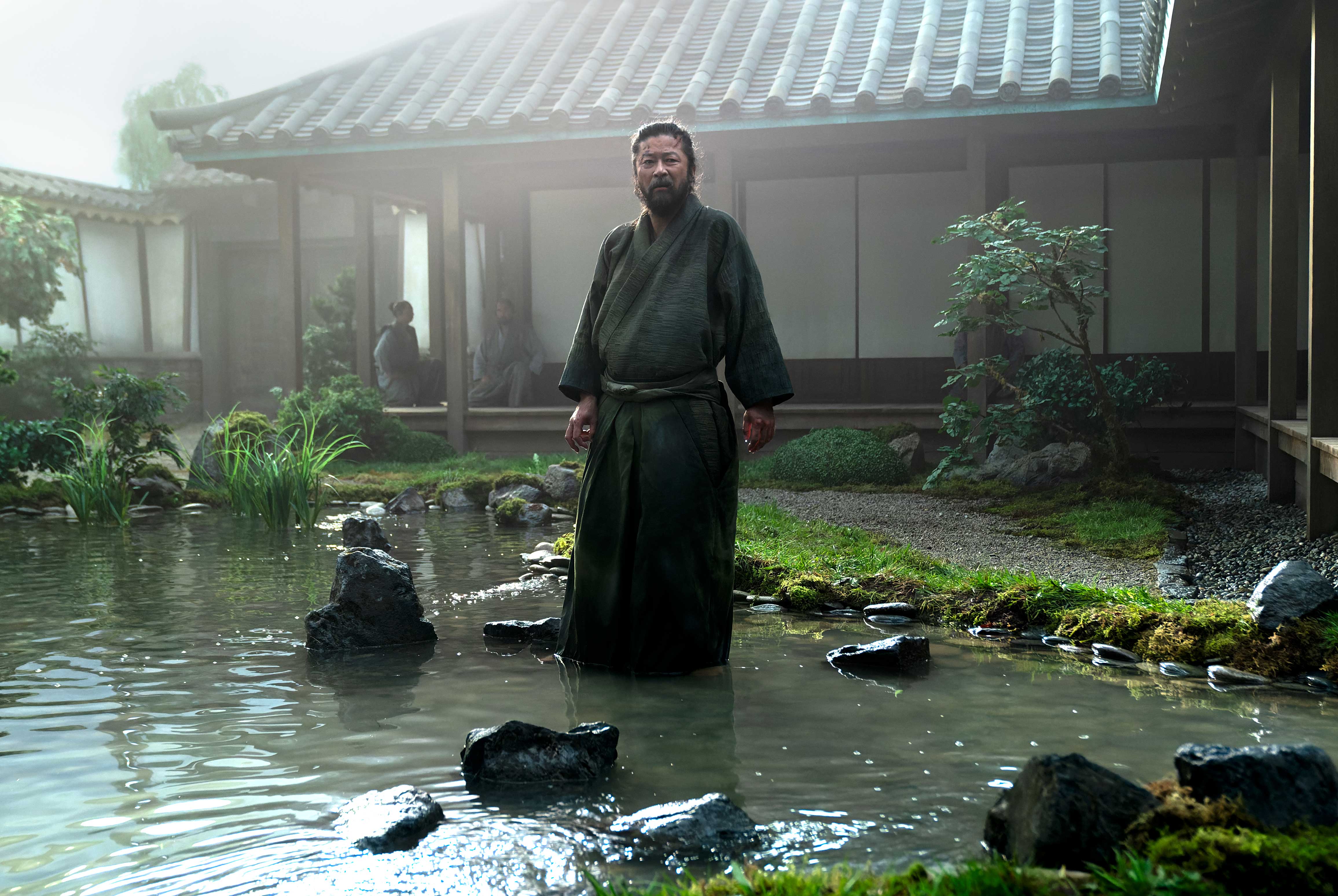
Something I love about the first episode of this series—and of course, some due credit to the script as well—there are so many different characters and so many different introductions and motivations and agendas that are just starting to bubble, and the audience is starting to understand who to be aligned with or to understand these relationships and dynamics in the story. How did you go about shooting that? A lot of times, in the way that things are framed, there seems to be additional layers to the framing to indicate more motivations or more potential allegiances amongst characters. I think the cinematography speaks to those complex and nuanced dynamics. Can you speak and elaborate on that a little bit?
Christopher: Yeah, absolutely. Working on the first episode or first two episodes of a show is a very specific challenge which is the introduction of character before the plot gets underway. The idea is that you meet a character undergoing some subtext and then later on that character becomes embroiled in our story in a way that you couldn’t possibly imagine. One of the interesting things about this script is how Toranaga’s character develops across the episodes, and how Mariko becomes a much more significant character across the episodes. So, one of the things that you want to do in an early episode is to set up the character in terms of an intriguing introduction but then also start to sow seeds of alliances. That was super important. In a conventional script interpretation approach, when Mariko is asked to become the translator for Toranaga at the end of episode one that leads into the scene at the opening of episode two, in a way, she could be a peripheral person. But what we wanted to do is to dissolve the lines of trust between the characters so that we already know that Toranaga and Mariko are in an alliance. And we wanted to then sow the seeds of the fledgling relationship between Blackthorne and Mariko. It’s all about very straightforward compositional choices to just have one character in the frame, but when you stack up a frame with—I think sometimes we have four main characters and eight samurai or eight ladies in waiting in the back of a frame, and when you can do that sort of storytelling, then the resonance that comes from the dialogue is much more strong. You get a much more emotional response when things go awry. What I hope that we were able to achieve in episode one is to create a relationship with the characters and the audience then one episode three comes along their lives are put in jeopardy, and when episode nine comes along Mariko is making a statement, making a stand, that the audience, their heart’s really behind them.
Well, thank you so much, Christopher. This was great to hear a little bit more detail about all the work you’re doing with the series. Like I said, it’s one of my favorite series of the entire year and so glad to congratulate you again on your work in it, on the Emmy nomination, and thank you for the time.
Christopher: No problem. Thank you very much, Danny. Thanks for the interview.
Have a great day and hope to talk again on another project, hopefully!
Christopher: No worries. Thanks, Danny! Take care. Have a nice day.


Comments
Loading…