

 Steven Prusakowski
For Starz’s Mary & George, Julianne Moore and Nicholas Galitzine play a mother and son who rise to power in 17th-century Britain through deceit, manipulation, and seduction. The series, based on Benjamin Woolley’s book “The King’s Assassin”, combines historical elements with an exquisite flair that can be found across the series in the characters’ attire.
To create this visually compelling experience, Costume Designer Annie Symons took inspiration from the underlying themes found in writer / director D.C. Moore‘s words, focusing on mood and color rather than strict period accuracy. The costumes Symons designed not only establish the setting of the series, they help tell the story of Mary and George’s ascension across social ranks.
Symons, previously won an Emmy for her costume design work for Great Expectations (PBS) has earned her second Emmy nomination for Mary & George. She spoke with Awards Radar about what goes into telling this British psychological drama through the costumes, tapping into the sensuality of the scripts, using art from the period as well as the original novel for inspiration and many more insights into what makes the series so alluring. You can read our full conversation below:
Steven Prusakowski: Congratulations on the nomination. It must to be a real honor to be recognized with your second nomination. This time for your work in Mary & George.
Annie Symons: Yeah, I mean, it is phenomenal. It’s when you look at the competition and how big the field is and you sort of really get a kind of sense of what an achievement it is to be nominated. Yeah.
I mean, it’s very, very exciting and very, very, feel very honored. Yeah. My whole team are ecstatic.
Steven Prusakowski: That’s great. And you should be, especially with the quality of television that’s out there. Everything that’s on television now has been taken to a level that I don’t think it’s ever reached before. So to be recognized amongst such high caliber work is an even bigger honor. So, double congrats.
Annie Symons: Well, thank you. Thank you. No, I mean, I’m okay to say I’m really impressed. I’m impressed. It’s phenomenal. There’s so much good quality stuff out there, you know.
Steven Prusakowski: When you watch Mary & George, you must step back and look at your work and go, ‘Yeah, that’s pretty darn good.” Because it’s so beautiful. Let’s get into it a little bit, because you don’t have a ton of materials to research. There wasn’t Instagram back in those days that you can reference. Where does your research begin?
Annie Symons: Instagram is the bane of my life. Well, I mean, it isn’t. I mean people are doing interesting stuff, but I live in London and we are very, very well endowed with galleries and near me, there’s a Kenwood House that has a specific collection of Jacobean portraits, weirdly. So, that’s the primary source. That’s what you do. You look at paintings and then I read stuff.
I mean, of course, Ben Woolley’s book, “The King’s Assassin” is brilliant because it sort of just opens up the world and opens up this detail in there. I do have a pretty strong baseline of historical knowledge and a thirst for knowledge. One of the best bits about being a costume designer is getting to find out new stuff, just looking at different shapes, trying to understand how those shapes arrived, the socioeconomic reasons for all that lace. Why things became softer and looser after this incredibly stiff, impenetrable Elizabethan, it becomes much more sensual and relaxed and as does King James’s court. There’s a metaphoric and symbolic reason for the evolution of clothing.
And just the way the script is written, it’s all about sensuality. It’s all about sort of people being unbuttoned and allowing true feelings instead of this kind of portly posturing to dominate the narrative. If you look at portraits of that time, they are a bit ridiculous. The shapes are so abstract and so bonkers, which is great because you know what your perimeters are, but then within that, you try and find a way of turning these garments into clothing that people would wear and feel comfortable in and not be dominated by these shapes.
When at one point I drove David Wood, my principal male cutter, insane because I threw one of the outfits in the washing machine to see what would happen to it. He was tearing his hair out. He said, ‘What are you doing? What are you doing?’ I said, ‘well, it might look interesting. It might soften it up.’ Actually it worked, you know. So, once he’d scraped himself off the floor and forgiven me.
Steven Prusakowski: Did he put his hair back in?
Annie Symon:s (laughs) Yeah, he put his hair back in. Yeah.

Steven Prusakowski: You’re trying to stay true to the time, but how much liberty are you given? Ae you able to inject some of you into the work as well?
Annie Symons: Well, yeah. Nobody knows the truth because all we have to represent it is what’s being written and what’s represented. And as I said, the representation is kind of symbolic.
It’s hard to describe how that happens. It’s a combination of knowledge and imposing kind of rules that work within the world, whether it’s futuristic, whether it’s Jacobean, whether it’s cavemen, and women you’ve got to find out your ground rules.
I started in fine art. I’ve been making clothes and designing clothes and costumes for decades, but I did fine art. So color is a really, really important thing for me and how it’s used as a signifier and how it’s used to weave through the narrative and plot stuff. And Mary changes color every time she moves into a different echelon of society.
color’s massively important to me, as well as shape. And I’m really interested in construction. Costume is a shorthand to character and narrative. It tells you a lot about the person you’re looking at before they open their mouth, or it should do. It should help, unless it’s deliberately to sort of red herring, confuse you. That’s fun, too, sometimes.
So I mean, there’s a lot going on in Mary & George, an awful lot. And I just found it one of the most engaging, intoxicating jobs I’ve ever worked on. I mean, intellectually, creatively, formally. And it was terrific, really. Hard work. Loads of hard work.
Steven Prusakowski: Mary evolves, as you touched upon, over the series where she begins and where she ends. Can you give me a little more insight into how her look had to evolve with her?
Annie Symons: Well she, women, women were nothing unless they had money or were married into money in those days. We were literally vessels for implanting seeds for the next generation. And what was interesting about Mary was that she was educated. She came from a really poor birth, apparently. But her determination and her politicking steered her and her family from poverty. But, well, I mean, relative poverty.
So the show opens and we see them in this parched, medieval, really desiccated environment where they’re all wearing bleach bone and stale bread colors. And she reinvents herself. Her husband dies and they basically lose everything because women had no value. And he drank all the, he drunk the family into the ground anyway. So her only option was to marry again. So she went through this brief period of mourning where she wore black, which wasn’t a particular thing then, but I just used it as a narrative point.
So she wears black and then wears these ridiculous pagan hair ears, which were a symbol of sexuality to go and snare her next husband at this party. And then she gets married in green, which of course is the color of fertility and new life. Actually it was a thing. People got married in green in Jacobean times. For those reasons, white didn’t become a significant thing till a lot later. And then she wears these sort of richer, more natural colors in her home with her new husband.
And then in London, she goes into the shadows a bit. So she wears these shadowy blues and purples and bruise colors. There’s a sort of, harshness about it, where she meets up with Sandy, who’s got her own thing going.
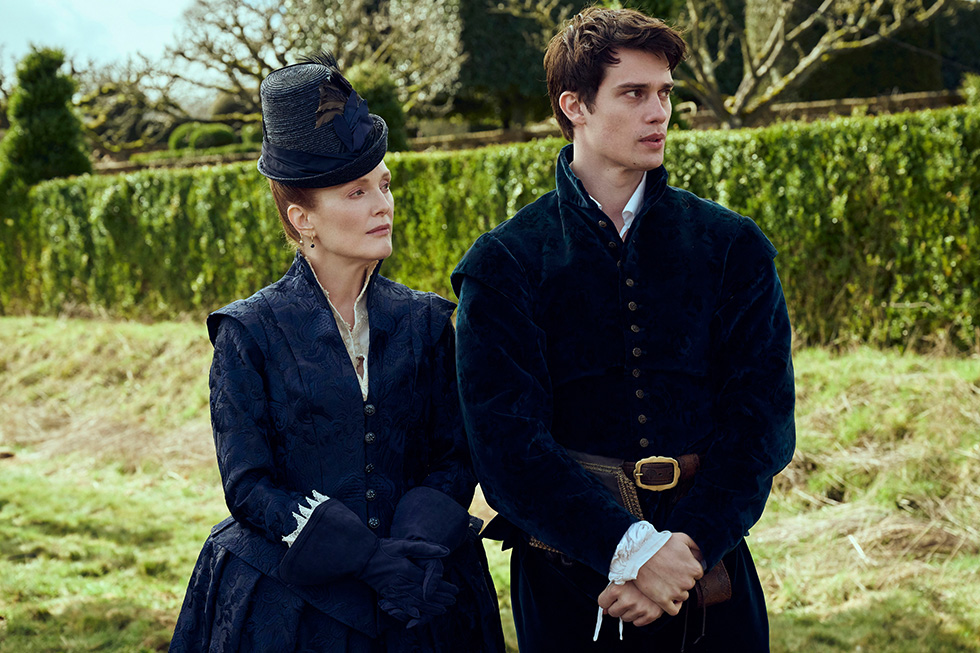
Sandie (Niamh Algar) just wears whatever she fancies, she sort of steals stuff, tries it on so her looks really eclectic and theatrical in a way. And then of course Mary wears this outrageous purple outfit, which is a grotesque sort of pantomimical version of the Queen, which obviously upsets the court, but gets her noticed. And then she starts engineering her son, who she also dresses to impress.
The King (Tony Curran) was really in historical fact, he loved stripes, apparently. So she dresses him in stripes, as do all the other young men to get the King’s attention. And yeah, thus it goes on and on and on.
And then there’s the red mask ball, where everybody’s wearing intense red colors, and it becomes very heady and heightened, because the mask was a very odd play, where metaphor and symbolism and things were said that couldn’t be said. I mean, I don’t know whether you know, but Macbeth was actually written for James, it wasn’t written for Elizabeth at all, so Shakespeare. So, he was really interested in plays and subtext.
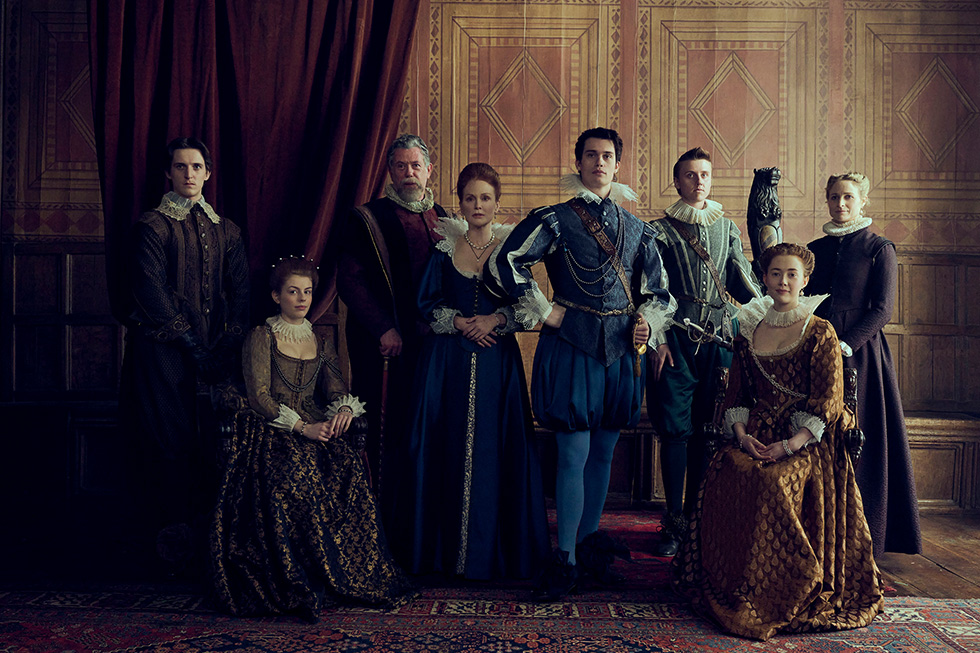
And then finally, when she makes it into the court, I mean, obviously, she’s wearing this purple monstrosity. When the rest of the court is in white that was the dress code, and she wears this horrible purple thing. But when she makes it into society, they’re all wearing blue, they’re in harmony, the court is harmonious, she’s arrived, and she doesn’t have to battle anymore. So the King, George, Mary, the rest of the court, they’re all in blue.
Steven Prusakowski: Is there a favorite costume you had designed for Julianne (Moore)?
Annie Symons: It’s quite a simple one, it’s velvet, and it’s got an all over embroidery design. It’s a jacket and skirt. So it’s quite modern, in a sense. But when I was designing for Julianne, I mean, she’s very petite. And so the shapes you put on her have to be exact and precise, just like Mary. And it seemed to me that it was edging towards Dior’s kind of new look a bit, which seemed to fit with her as a kind of proto-feminist dynamic modern woman in this world of this old world that she was trying to forge her way through.
And I like that outfit a lot, because it’s simple, and it really suits her and says quite a lot without overstating anything, I think.
Steven Prusakowski: I mean, there’s so much you can touch upon, but I’m pretty much out of time. So I just want to end with this one. What about unexpected challenges?
Because there’s such a vast array of costumes, and so many things like it. And obviously, you’re telling the story through the costume. So which one was a bigger hurdle than you expected?
Annie Symons: There were daily hurdles. It was a beast of a job. But you know, that’s part, I mean, problem solving is part of it. And actually, it’s quite a cool part of it. But D.C. Moore, the writer, I mean, he kept writing scenes where people were falling in water. And then he’d write a scene where everybody was in the water. As I said, if you write another scene like that, I’m literally going to strangle you. What do I find? He just did it to provoke in the end, I’m sure of it.
Because obviously, you’re shooting out of sequence. And you have to get a cast of these ensemble scenes, whether it be eight or nine people in it with multiples ready in a super short space of time with wet suits underneath. And I mean, all that kind of thing is just par for the course. It’s technical. What we do is technical, as well as creative.
Steven Prusakowski: You can’t just make something pretty. It’s got to work. You’ve got these actors, and they have to do their job. They have to tell the story.
Annie Symons: I really wanted these costumes to be clothes, comfortable clothes, that people could move freely in them.
Steven Prusakowski: And focus on telling their story.
Annie Symons: Exactly. Exactly.
Steven Prusakowski: I’ve heard a lot of horror stories of people who had to spend a whole film or a whole television series wearing something that obviously demanded their focus because they talked about it afterwards. Doesn’t sound like that’s the case here.
Is there something you’re most proud of? It could be one piece of clothing or just part of the your job, or what you brought to the series?
Annie Symons: Well, I think I think three banquets in one week’s got to be an all time high. I’m pretty proud of that.
Steven Prusakowski: Did you sleep at all?
Annie Symons: Sleep? Nah, it’s for the weak. And I was very, very proud of my team, the sort of level of expertise and passion they brought to it and curiosity. I think everybody was so excited to be doing a period that hasn’t been done before. I mean particularly Marija Radojicic who did our ruffs and whisks and collars and cuffs.
I mean, she was on fire. I had to send her home, ‘You cannot do 18 hour days. Go home.’ But she developed techniques that were so fast. It was phenomenal. People were really engaged and really excited. And you can’t buy that. They just wanted to do it. I mean, obviously, they got paid, but I mean it was very special. It was a very, very special project.
Steven Prusakowski: Well, the passion, the skill and the artistry all show up on screen. So thank you so much for your time today and best of luck going forward.
Annie Symons: Thank you. Thank you. Nice to talk to you.
(The interview was edited for clarity.)


Comments
Loading…