
 Steven Prusakowski
The actor Sam Neill has graced our screen for decades. For Peacock’s Apples Never Fall he plays a character who may just rub viewers the wrong way. The character of Stan Delaney is a retired tennis player who becomes a prime suspect in the disappearance of his wife Joy (Annette Bening). The drama navigates through layers of family secrets and revelations that shift loyalties even within the family tree.
Sam Neill sat down with Awards Radar to discuss his work on the series and how he made the less-than-likable Stan a complex character who keeps viewers guessing right until the end.
Steven Prusakowski: First of all, thank you for doing this. I appreciate it. I’m a long-time fan. What initially drew you to joining Apples Never Fall?
Sam Neill: What was the… I think probably Leon Moriarty. You know, I’d seen Big Little Lies, and I just thought that was fantastic. Then, I read the story – I was very intrigued by it. And then I thought about the character, and I thought, oh, God, I don’t know. Maybe… I’m not sure.
I wasn’t at all sure about whether I was right for the part. You know, that kind of gung-ho tennis jock is so far from anything that’s familiar to me – that sort of alpha male bully thing is something I’m not very comfortable with.
But then, you have to remind yourself, this is acting… You’ve got to stretch. And so it was a stretch for me, and I’m pleased I did it.
SP: He’s not like you, at least what we know of you. And he’s really not the easiest person to kind of like. He’s abrasive, he’s arrogant, plenty of flaws. So how do you prepare yourself to get into that role? How do you shift from Sam Neill to Stan?
Sam Neill: Yeah, there’s not a lot to like about Stan. But that’s the stuff isn’t it? That’s the good stuff as it happens, you know? – from an actor’s point of view, that nuance. If I’m looking at it objectively, because you don’t do that while you’re actually in performance, because you should be inhabiting the character, but if you look at it objectively, this is not a likable character.
But on the other hand, you need empathy as well, with people. And I think you need the empathy as an actor. There was something about Stan that I felt sorry for. It turns out, he is damaged. He’s damaged by an abusive, a physically abusive father. And these things affect you for your whole life.
So there’s something, you sort of understand so much of that insane drive that he has, his standards that are never met by his children. I sort of get it. Because I think I got under his skin.
SP: It’s not about liking him so much as starting to understand where the seeds of the abrasiveness, the arrogance, the shields he puts up, where those originated. It’s easy to empathize with someone who’s like you, who has the same perspective, or has the same upbringing. But for an actor, I guess you have to put yourself in the shoes of somebody who was on the other side of the tracks.
Sam Neill: He’s from a different generation as well, you know. And these things are generational. So much of Stan is imprinted upon him by his childhood and his own father. These are things you can’t help.
SP: When you start off with Stan you kind of despise him, but that changes somewhat. It is possible to feel sad for these “villains” or the the unlikeables, because they didn’t want to be that way.
Sam Neill: This is especially true as everybody turns on him – everybody. Even even his most favorite daughter. That’s just so cruel. When your daughter turns on you, when the one who had your back since you were holding her in your arms and carrying up the stairs and all those things, and then that shifts. Yeah, something’s not right. Yeah.
SP: And with a series like this with an ongoing mystery, where we don’t know who’s behind Joy’s disappearance, right until the end. Does not knowing about the character’s guilt or innocence affect the way you play him?
Sam Neill: No, not really. I was playing it entirely from Stan’s point of view. Whether or not Stan’s done something bad, he would still see it as being the right thing. That’s a given, you know, he’s not a man given to doubt. Not until everything falls to bits around him.
SP: The scar on your face probably helps you flip that coin and become the other version of Stan. Do you use triggers like that with your roles? When you’re thinking ‘Okay, how do I slip into this character?’ I’ve had actors tell me they used a potato in a basket. Another today was talking about doing a little ballet.
When taking part in a little ballet that shifted her into that mindset of who her character was, because she did not do ballet on her own. Is there anything like that that you use? Any tricks?
Sam Neill: Yeah, I always have a little motto. I always have a very simplified motto to get into the character of Stan is just like this, and I would repeat the motto to myself, “I’m Stan fucking Delaney. I’m Stan fucking Delaney.” That was a great thing to switch into a Stan reality. The emphasis on “fucking.”
SP: Is this where the interview goes downhill?
Sam Neill: (laughs)
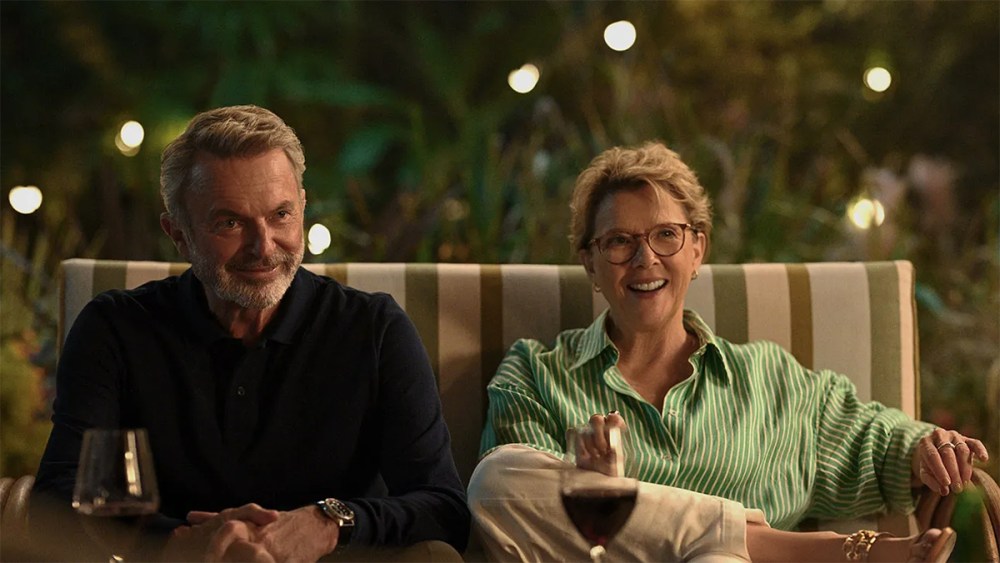
SP: What’s it like working with Annette? Was it tough having to fight it out on set?
Sam Neill: (jokingly) Hellish. So she was hellish? No, I’m very fond of Annette. And you can probably use a tennis analogy, the better the actor that you’re working opposite, the better your work is going to be. Like the better the tennis player you’re serving up to, the better your return will be.
And we got on really well, very close on set and, and we never had, we never had a disagreement about anything. That’s a very useful thing, particularly when you’ve got some really difficult confrontational scenes to work with. But, we implicitly trusted each other and it was a really good working relationship. Really good.
SP: It’s like on the opposite end of a love scene, having a fight scene and having to go and chew each other out and yell and get this close to physical. Is there a handler on set or anything like that?
Sam Neill: We did have an intimacy coordinator who Annette turned to her and said, “You know what, we’re going to be absolutely fine, but thank you so much.” (laughs)
And we didn’t see her again. We were absolutely fine.
SP: Throughout Joy’s disappearance, it’s almost as if Stan wants attention. He doesn’t just put up a front stating he did not do it. Instead he always has excuses like, she was at a doctor’s appointment. There’s these little fibs that he ends up getting caught up in.
Is that part of who Stan is? Is there some reason that he couldn’t just alleviate the doubt and suspicion had in him?
Sam Neill: Yeah. It’s interesting that he does that. I’m slightly puzzled by that myself. I mean, I think it’s good to leave certain things ambivalent. You don’t need an answer for everything. And sometimes people do things that are, that are out of character or are simply misguided.
Those strange deflections, I don’t think I fully understand them myself. And, and I’m not sure that Stan does, you know? There’s a part of Stan that doesn’t really want to face reality. There’s probably three or four reasons why she’s gone – none of which he wants to particularly address. So there’s a bit of Stan that’s thinking, “Oh, it’ll blow over. It has before.” I think it’s the answer to that.
SP: One last question, the tennis, it looks so natural. Are you a tennis player or was that just acting?
Sam Neill: I tell you what sort of a tennis player I was, I’d never served overhand before. It’s one of the reasons I was a little reluctant to take this on. But I got some great help and I think we ended up being pretty convincing.
SP: Yeah. You look good. Do you continue to play at all now?
Sam Neill: No, I don’t have a tennis court. It’s well, it’s nearly winter. Yeah, my pond is frozen. I might go skating.
SP: That sounds great. Thank you so much for your time. I’ve been a big fan over the years, In the Mouth of Madness, of course, Jurassic park, The Omen, Hunt for the Wilderpeople. It’s been great watching you through the years and I look forward to seeing what you do next.
Sam Neill: My pleasure. Thank you, Steven.
Apples Never Fall is streaming exclusively on Peacock.


Comments
Loading…