

 Shane Slater
With its delicate, observational approach, Brittany Shyne’s Seeds was a standout at the Sundance Film Festival, duly winning the coveted Grand Jury Prize among US documentaries. The film follows the lives of Centennial Black farmers whose generations-spanning livelihoods are under threat. Since its premiere, their stories have captivated audiences and won numerous prizes on the festival circuit. Ahead of its latest kudo The Maysles Documentary Center’s Albie Award, Awards Radar talked with Shyne and producer Sabrina Gordon Schmidt about the making of the film and its critical conversations surrounding land ownership and Black legacies.
Shane Slater: What was the genesis of this project?
Brittany Shyne: I started this film in 2015. At the time, I felt like there weren’t many films depicting black farmers and the agricultural landscape, and I felt like they have made so many contributions in the world, and they have been integral to the American fabric of society. And yet, they’ve been really under acknowledged. I really wanted to highlight them in a way that we really haven’t seen before. And also, my family’s background comes from agriculture. My grandfather owned land in Homer, Louisiana, and then my grandmother and my grandfather were sharecroppers in Belmont Mississippi. And so I really wanted to do a story that really talks about legacy and all that entails.
SS: How did you go about choosing which communities you would focus on?
BS: I was really interested in Centennial farmers, and so I was really looking for Black farmers who own land for generations. And one of the oldest farms was in Thomasville, Georgia. They’ve owned land since 1883 and it’s actually my mother who found an article about the family and about how they acquired their land. And so I knew that was going to be a focal point within this film. How are these families able to continue on and on? And so later on in the story, I found out about Willie and his story about how his father and his grandfather, acquired land. And so that was my starting point to kind of focus these families in the South, particularly in Georgia.
SS: How did you land on this observational style to tell their stories?
BS: For me, I wasn’t really interested in doing something very didactic or formulaic. I really wanted to embed ourselves in the rhythms of the everyday. So the film is very languid. It’s very unhurried. I feel like this was a space where time moves slowly. And I want to emphasize that. What does it mean to be in the South with these long days? Sometimes nothing momentous happened, but it’s small things that kind of take shape and become revelatory. Throughout the film, it was like building a quilt.
I think with this film, many of the elders were kind of at a tenuous and fragile place in their lives. It was another chapter. So things were naturally slower for them. And so I think I just mimic that, you know? So it was just really me by myself and with the camera. And I think it was important to really understand what these black rituals look like, in a way that wasn’t just explanations.
SS: There’s a level of intimacy and trust that is conveyed in the film. Was that connection with your subjects immediate, or was it something you had to work on?
BS: I was very lucky. Maybe because I was by myself for the most part, that intimacy developed pretty quickly and that trust. I was a young woman going down there, and I didn’t have a large crew. So I think they trusted me, wanting to tell their stories, and wanting their family’s lives to be told in this capacity. At this point, there are not many films I feel that are really focused on elders. And I think because of that, it made it a little bit easier for me to kind of come into this community. They have all these kind of stories, and they treated me like a granddaughter.
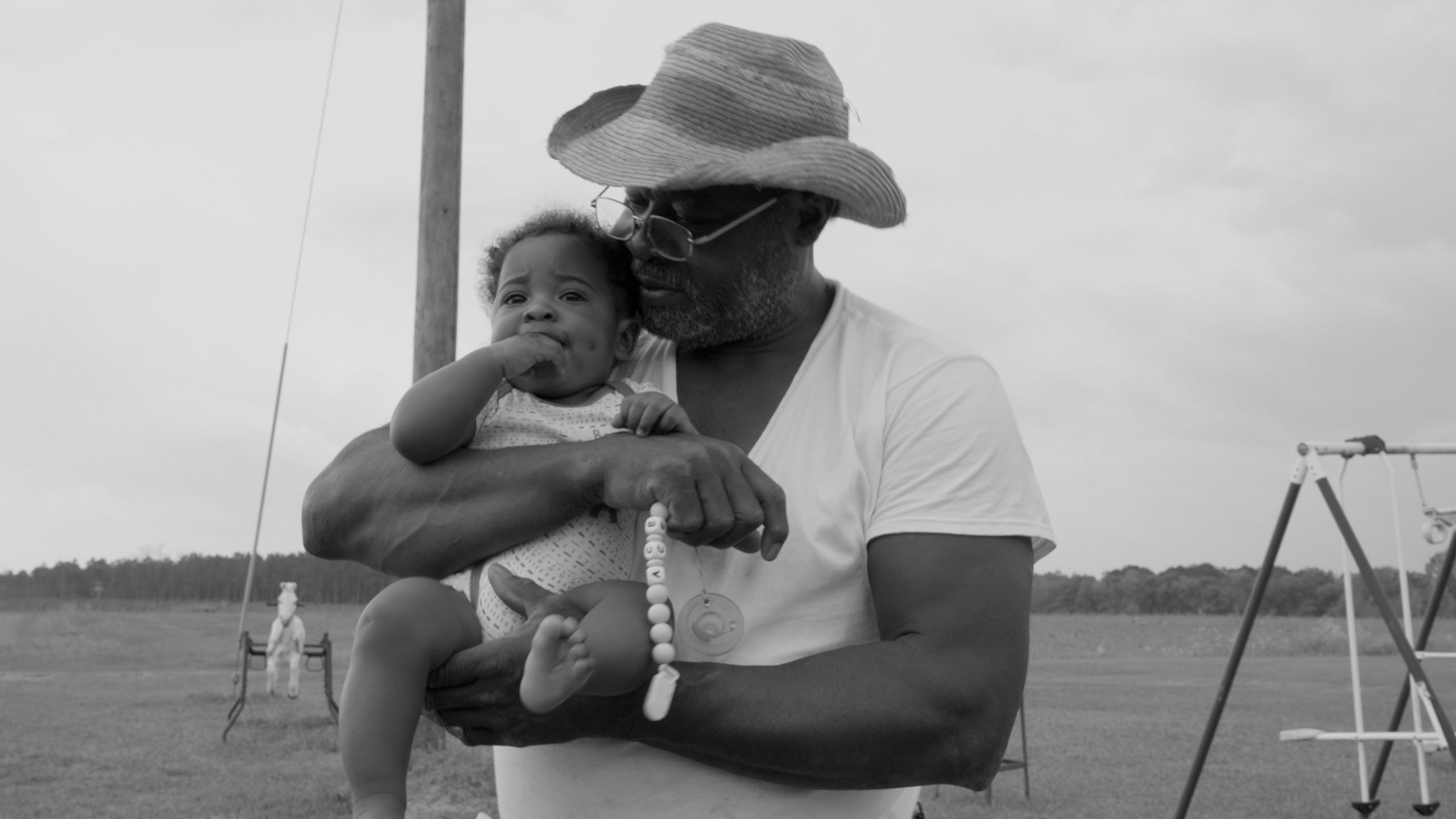
I really wanted this film to be rendered with tenderness and love. I think a lot of times we think about the plights and adversities of Black farmers. But I will also wanted this to be a communal space of sanctuary and understanding. What does it mean to be tethered to to a land? What does land ownership mean, and how could land ownership be a respite from the outside world? And so, it was important for me to incorporate these kind of soft and loving moments. And then we see that with Willie Head Jr. and his granddaughter, Alani.
SS: Was it a deliberate choice to highlight the father figures in this community?
BS: I think it was just natural for this particular community. I mean, luckily, I met these really incredible people, and we see how much love and care that they have for their children or their grandchildren. So I think I was just at the right point in time where we kind of understand the urgency of why they’re so wanting to protect this land and why Willie is building a house for his grandchildren.
SS: The latter half of the film stands out as more pointed and activist-minded, firmly placing it within the time of the Biden administration. How did you approach the film’s structure to get to this place within your observational approach?
BS: I think that’s a very pivotal point in the film. And I think, working with my editor Mallika, who did a phenomenal job, it was really for us to understand their everyday lives. Willie is an activist. He is a political person. And he’s been fighting this fight with the USDA for over 30 years. But I didn’t want that to be the main focal point, because there’s so many other elements to him. But I think it’s so vital. And I think when it comes towards the end, we understand why this means so much to them and as a community. You know, this isn’t the first time they went down to Washington. This isn’t an issue that just happened. It’s a recurring thing. And I think it was important to set it up where all these things come together, and why this administration has been like this.
Sabrina Schmidt Gordon: I think we have to remember that this is what was happening at the time, at the time that Brittany was following them. So it’s not as if it was a contrived thing. And I feel like, as a doc filmmaker, and especially one that makes films around social justice issues. I’m always looking for ways to tell the story that doesn’t have to be like a talking head explaining it. I think people’s lives are innately political, and if you follow people long enough, those things are going to move in and you just have to trust them. And the audience experiences them in a completely different way than if you’re just explaining from a historical place. So I just wanted to point out that it was what was happening, you know? And I think that makes it all the more powerful.
SS: Was there anything unexpected that changed the course of the film’s storytelling?
BS: My film is a film that I’ve been working on for so long. So our film took shape in many ways. You know, you acquire all this footage, but my film isn’t like a topic. It’s a topical film, but it’s a very subtle film in many aspects, right? And so trying to build all these little moments to make meaning out of it took a while to take shape. A lot of the film, we see all these family members in cars, and that becomes a motif as well. It’s a multi functional space, you know? It’s a space of community and conversation. But also is transportation where we see handing off greens and turnips to neighbors. So it’s kind of like finding ways to add meaning.
I think that one of the changes, or I think one of the most pivotal changes, was when I started following Willie, because Willie’s an activist and he’s in a political framework. I think that changed the momentum of the film. That heightened, I think, the urgency of this kind of space, which I think helped us to edit. One of my favorite moments is actually the scene with Alani and Willie at the grocery store, at the Dollar Tree and I was filming them in the car. A neighbor recognized him because of his activism, and that whole conversation took place organically. And you really start to see his impact.
SSG: When you’re talking about the political stuff coming at the end, it’s kind of peppered throughout. It’s just kind of innate. Organically, it happens in his life. There are other moments where it’s referenced. It’s just kind of within the flow of his life.
Whenever you’re doing, like, a verité film or observational film, and you’re an independent filmmaker trying to raise money to get support to do that work, people want to know, “What’s going to happen? What’s it going to be about?” That was maybe a bit of a challenge for people who want these clear cut answers. So for us, I think the solution for that was that the funders trust the filmmakers, trust the team. And clearly, there was a vision in the film, our aesthetic and otherwise. And like I said, doing this for a little bit of time, if you follow anybody, the person becomes political and vice versa. You will have something no matter what.
And I think even the choice to pick elderly Centennial black farmers is already disruptive, right? Because we never see see that. So that’s a story already that’s not been told. So I felt confident that would be a story, but the challenge is to get that support to trust that vision and hopefully Seeds can be a really great example. See what happens when you trust filmmakers and you trust the vision, you know? We have a really beautiful, award-winning film.
SS: Now that your film is out in the world, what impact are you hoping for through its release?
BS: I think there are so many diversity programs that have been dismantled, and I think we are at a very particular time where these stories are so important. They’re so critical to really understand who’s really taking care of this environment, who is part of this ecosystem and of sustainability. So for me, the sad thing is, this isn’t the first time it’s happened. It’s nothing new, right? It’s just in a different place, in a different administration. A lot of these black farmers are being resourceful in ways that they shouldn’t have to be.
I think for us, we hope to have stories like these, so they don’t have to have as many hurdles and obstacles and bear as many barriers. So we hope to do a lot of things that support these farmers, and to really think about land preservation programs and ways to make a more sustainable future for them.
SSG: I do impact with all of my films. And I think particularly in this moment, in this political moment where it is very hostile, what are we going to do to make the world a better place for people? But I think that you can still create impact. Because impact often we think about in big, political terms. Like, we’re going to have this legislation or whatever, and actually, those things were being undermined, as we see in the film. But impact will also be within communities that’s sort of macro and micro. Sometimes, if you make a difference in somebody’s life, or in the community, that’s plenty, you know?
When I think about this film in a larger scope, hopefully this could be a film that can sort of revive the conversation around Black land ownership and what that means. Not just in terms of, like, a strategic economic thing, but like Willie says, it’s about freedom, it’s about liberation. And we have lost a lot of that land. And so maybe one of the things that we can do concretely, that we don’t have to rely on the government or any initiative or program to do, is to get young people, a new generation of people, to really appreciate what these farmers, these families have built for generations, becausae everyone wants to go to the city. That’s always where they give their attention and concern.
I think also even the way they create community is an example in itself. And that’s certainly something that would resonate with the current political moment, because clearly we have a very fractured, hostile kind of space we’re moving around in, and that sort of is the exact opposite of, and obviously an ideal to aspire to, because we see how they take care of each other. Even when Willie delivers the collard greens, or turnips, and they don’t have enough money, and they said, “Oh, come back for it later.” You know, you take care of people, and you trust people and it’s not just about you.
And I would also say, even in terms of climate change and political stuff, there’s that scene where they’re talking about the seeds and how you can’t buy them. And there are certain seeds that you can’t use. So they have come up with a kind of ecological and holistic way to maintain their seed to provide for themselves and for their community. So there are plenty of things that the film can do, concretely and even more abstractly, you know? Storytelling always has impact.


Comments
Loading…