

 Shane Slater
There has been no shortage of films surrounding sexual abuse in the wake of the #MeToo movement, emphasizing the power of speaking up for justice. In his debut feature Julie Keeps Quiet, however, director Leonardo Van Dijl takes a different approach. Using the world of competitive tennis as a framework, this thoughtful drama follows a young aspiring tennis star who becomes embroiled in the sexual abuse investigation involving her coach, yet maintains her silence. Following its selection as Belgium’s official Oscar entry for Best International Feature Film, Awards Radar caught up with Van Dijl to discuss the making of the film, its themes and the parallels between coaching and directing.
Shane Slater: This is a quietly daring film in the context of the #MeToo movement, in that it centers a character who keeps silent after abuse. What made you interested in taking this approach with this character and this sensitive issue?
Leonardo Van Dijl: I started the project five years ago and I was like, “How will the world look like in five years?” And that’s why I don’t like to even use the term #MeToo too much, because then, these words have their momentum, and then we get tired of it. The interesting question was, “What is a new generation going to do with the whole public debate that we have held so far?” Ultimately, it’s a very simple statement that I want to say. It will always be hard to speak out. How much safety will there be? Julie did not choose for her silence to get the attention and to be in the center because of it. Everything was imposed on her and and therefore it’s hard to speak up, and it always will be.
I want to bring back some sensitivity into that narrative and to show it will always be hard for children to speak up. For boys and girls like Julie, for every silence that is broken, there is silence. Before somebody is speaking up, there will always be somebody keeping quiet. I felt that it was a movie that I haven’t seen yet. So much is invested in speaking up and all that. But I was like, “This is bizarre.”
This is the origin story, in a way, and it has not been told yet. I wanted to tell it that way. Julie’s silence can be yours, you know? We all carry silence in us, and we all struggle sometimes to speak out. And I wanted it also to be a story, not about a hashtag, but to be a story about the human condition.
SS: By the end of the film, it gives you a sense of empathy towards her actions as a kind of courage. Were there any specific decisions you made in the writing in order to get the audience to feel this way?
LVD: I really like the fact that you say courage, because I think we feel the same. I didn’t want to impose a movie where this girl of 15 needs to be powerful. We have learned so much because of the hashtag #MeToo. And we needed it to get out of something. But where is the world now? What are we going to do? How are we going to prevent girls and boys like Julie from falling prey to that history that is repeating itself. We are still putting the pressure and responsibility on a victim to speak up. And I do think there is an injustice in that. We should prevent these victims first of all, from the silence that you know they fall prey to.
But also, I think sometimes, in some situations, we know enough. And we can organize the situation without putting that pressure on Julie to break her silence in order to create justice. What was so nice about this movie is that I had a lot of time to to do research about safe child practices and how we can be preventative. How we can empower children in a healthy way, how can we make sure that they feel safe and encouraged. But at the same time, taking agency where they should be taking it, and not where it’s imposed. That was so nice because I also learned that it is possible. There are tools, but sometimes we as society still struggle to apply them.
SS: Were there any particularly interesting responses to the film from audienecs, considering your approach and how sensitive the topic is?
LVD: For me, the most special moment was when I was at the Cannes Film Festival, and three days after the premiere, I was walking on the Croisette, and a guy came to me and said, “I saw your movie, and afterwards I went and called my daughter. And we had a very important conversation.” Maybe it was just small talk, but they connected as father and daughter. And he said, “Thank you so much, because your movie gave me the courage to call her.” And that for me, was so welcoming, because I made a movie called Julie Keeps Quiet and it’s encouraging people to speak with each other in a soft way, a sensible way, in an intimate way. Not for the sake of having to speak up, but with the intention of, “I want to talk with you, and I want to know how you are doing.”
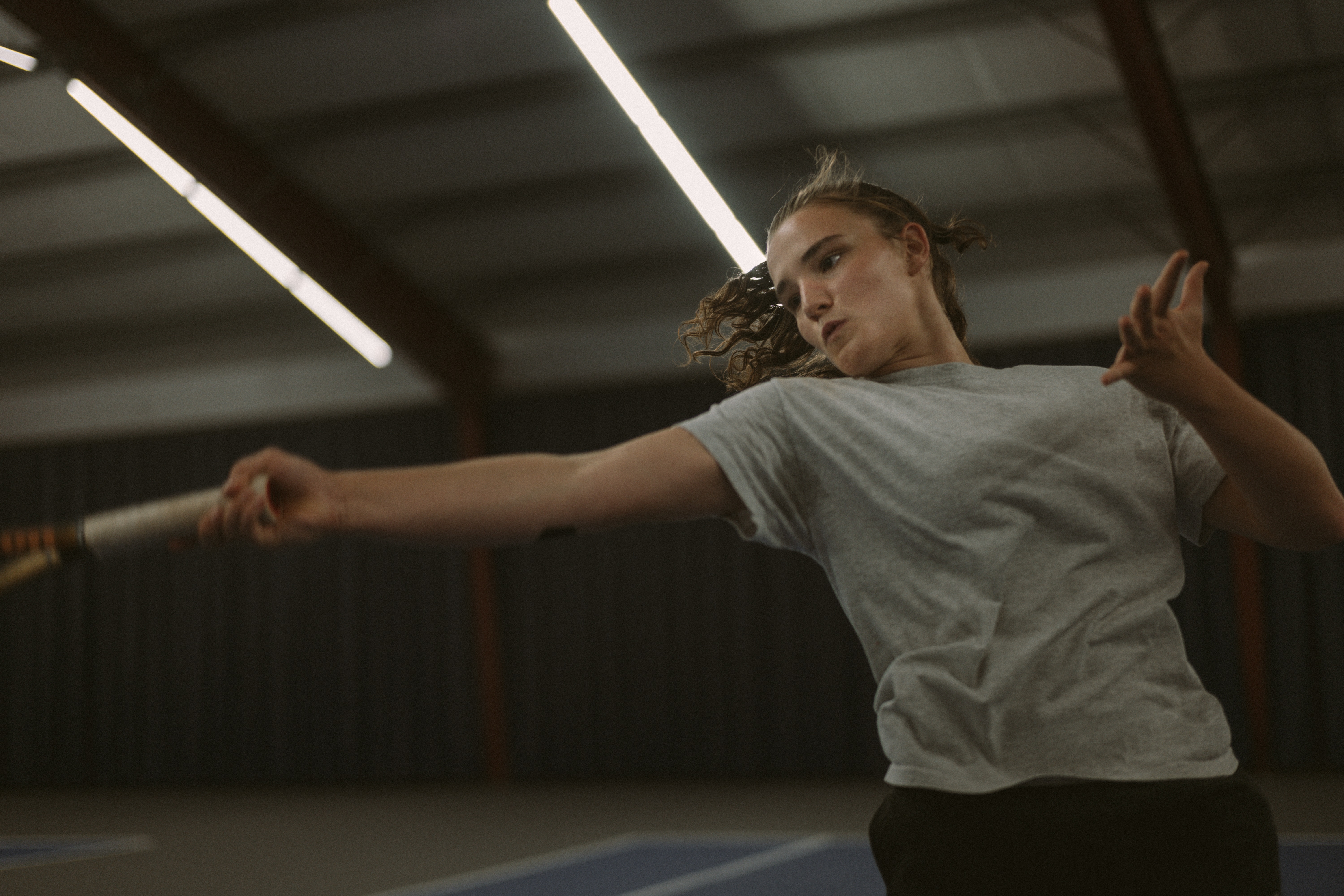
SS: Your lead actress is so effective in this role and also, as someone who watches tennis, her background in the sport is obvious. Was that a happy coincidence?
She’s incredible. She did things on the screen that I have never seen in my life. I wish I could say that I created it all, but it’s not true. There was a scene in the movie where she gives credits to the coach, and the physiotherapist says, “No, it’s you who was hitting the balls.” And after we saw the movie I said, “It was you who did it. You were saying the lines.”
I always knew that I had to work with real tennis players. And you need to catch the talent, you need to spot it. Then you have six months to prepare them for the set. And Tessa walked in, and it was obvious, she had the glow over her, you know what I mean? She was just radiant. And it was obvious, such a happy, chatty child will give depth to Julie. Because for me, Julie is not a quiet girl. She’s actually, a very strong, empowering, chatty girl. Just about certain things she doesn’t like to speak, and then she becomes an introvert. And with Tessa, she had a very good approach about understanding the character.
I learned quickly on not only with her, but with all tennis players, that they are fantastic actors. And I was really like, this is going to be so much easier. Because the thing is that tennis is this technical sport. It’s very technical. And you need to be kind of, street smart. And all those kids have that. So first of all, they have experience with being coached and getting feedback. So in that way, me being director and telling them this and that, they’re happy to bring it. And they dare to try. And that’s great.
Tennis really demands a full package. You need to be disciplined, you need to be independent, smart. And then you need also, to have some guts. You need to dare to improvise. And you know, if you play a game, there is no coach telling you how to score. You have to work with everything that the coach has given you. But then, you decide the dance, and it’s the same with acting in that way. So in a bizarre way, the sport made it so easy. They opened the door for me. And we even used the terms of tennis to explain scenes. Where, say, you’re more in the defense or you’re attacking.
It was always the intention to work with real tennis players, but, yeah, the coincidence is that they happen to be great actors. So, everybody wants to work with minors, I would just say, go to the tennis clubs and go scouting there. There is talent, for sure.
SS: It’s interesting how we’re talking so much about tennis and yet, it’s not really a sports film. You mostly portray the practice sessions, but there’s a kind of rhythm to how you’re depicting it. How did you approach the tennis and also the look and feel of the film? This is so different in tone and style to the other big tennis film this year – Challengers.
LVD: I’m a huge Luca fan, so when I heard about it, I was like, “Oh no!” Because he has a huge influence on me. And I was really like, “What if it’s gonna be exactly the same?” Luckily, it wasn’t. And, you know, I’m so grateful, because in a way, Zendaya picking up rackets just opened the door for the small Belgian, Julie. The only thing we had to do was walk in, and everybody is almost comparing it, you know? And so, I like to thank Luca, Zendaya, Josh, everybody there for doing that, because this is a very sensitive topic and I guess we could use a little bit of pop, a little bit of sparkles, I guess, to actually talk about the well-being of Julie.
For me, tennis is almost like a meditation. Julie, in the beginning of the movie, is extremely disconnected from herself. Her body and mind or somewhere else. But every time she sets foot on the court, she reconnects, you know? The soul comes back into that body, because she’s starting to get that relationship with that ball, and she starts to own it. And I think in sports movies, we see much about the victory and the pride, but the life of an athlete is mostly what you see in my movie. And how you sit with that, and how you bear with the unexciting stuff, you know? Like, you live four years before you go to the Olympics.
I wanted to show that because if you want to see a great tennis game – even if I have fantastic tennis players – you just watch the US Open, you know what I mean? It will never be the same staging it. So I wanted to tell something that you didn’t see on the big screen yet. So the focus on the practice, and also like the choice for example, do it on 35 mm because it creates a separate look that distinguishes itself from what you see on the sport channels.
[This interview has been edited for length and clarity]


Comments
Loading…