
 Shane Slater
At first glance, the premise of They Will Be Dust – a couple contemplating mutual assisted suicide following the wife’s incurable cancer diagnosis – sounds like a rather bleak prospect. But for director Carlos Marqués-Marcet, this sensitive topic provided an avenue for music and comedy amid the sorrow. Starring Angela Molina and Alfredo Castro as the ill-fated couple, the resulting film is an audacious take on life, love and death. It was therefore a pleasure for Awards Radar to sit with Marqués-Marcet to talk about the film’s influences and his approach to handling the tricky material.
Shane Slater: The title and premise of this film suggests something heavy and morbid, but there’s such a strong sense of humor. How did you arrive at this approach to telling this story?
Carlos Marqués-Marcet: Yeah, I think this is not a movie about grief, about losing somebody. The grief is more about how to confront your end of existence somehow. And this is not something sad, it’s something weird, you know? It’s something strange and sometimes absurd, especially when you also take the decision to not wait until the end and you have to go into this crazy situation, like, “Oh, are we doing it on Monday or are we doing it on Friday?” And that, to me, is very strange.Trying to conceptualize, trying to feel it. And it was important to us to get there and humor was a way to go there. The same way that music was. Obviously, it’s sad sometimes too, but it’s not always sad, you know?
SS: Had you worked in this musical style before? What is it like incorporating the songwriting and the choreography?
CMM: I think music has always been very present in my movies. And actually, I didn’t realize, but a critic friend told me, “Have you realized that in every movie you have a scene where people dance?” I hadn’t even thought about it, you know? But it’s actually something that is present. But this time was the first time doing a musical. And it was hard because obviously I’ve never done anything like this. I’ve never even done a music video. I love music, I love musicals. Especially from the 30s, 40s and 50s, you know? The really old ones. Film musicals, more than theater musicals, I have to say. But at the same time, I was completely lost.
In Spain, it’s a lost art nowadays. It’s very hard. And obviously, I read a lot about it and how they used to make them. And I’m trying to recover a little bit of this flavor. But then at the end, it was just getting into the work, you know?
The collaboration with Maria Arnal was very important. She’s this amazing artist, singer and performer. She doesn’t do music for films and all her work revolves around the voice as an instrument. So she’s working on making voices not just to sing, but to make music. And that’s a very long tradition, you know? And for us, this idea of trying to make something very contemporary, but at the same time, something that feels very ancestral. That goes back to the beginning of times. And singing is the oldest expression, and then drums. It was getting to the two most basic elements, drums and voice. And just using these elements, combined in a very contemporary way.
It was a lot of fun to make the lyrics too, because we would sit with Maria and come up with ideas, with a lot of inspiration from this Spanish poet, Francisco Gómez de Quevedo. There’s a lot of inspiration from the Siglo de Oro (Spanish Golden Age) and the Baroque era. They were very funny and weird and strange. And very romantic in a way. Not romantic in the straight sense, but very deep and metaphysical. And I think they’re the best sonnets about death in Spanish language from this time and are very inspiring. So actually, there are even some of Quevedo’s verses in the lyrics. So a lot of inspiration came from that.
SS: The film is very self-aware in specific scenes. Can you speak more on that?
CMM: Yeah, that actually comes from the same place, you know? It actually comes from this inspiration from the Spanish Baroque. And to me, it was very interesting because it was a very difficult moment in Spain, when death was very present. Three years of famine. It kind of took over.
I feel that in the Flemish painters and Dutch painters also, in a different way, they were very obsessed with death. And somehow, I think they become so good at being realistic, that then they became meta-realistic, you know? And there were all these painters and writers, like Pedro Calderón de la Barca, who started to make all these meta-fiction. When you start to paint something with too much detail, then the painting itself becomes the subject. And to me, it was something that makes sense, because to talk about death as the extinction of self, it’s very hard, very abstract.
One of the most efficient ways for me, is to just talk about representation. You cannot talk directly about the thing because it’s very abstract and very strange and weird. There are no words. You’re not able to put words to express this feeling. So let’s use the representation of this in order to be able to approach a little bit closer. And somehow it’s the limit where representation kind of breaks. And that’s where theatre came about in this movie. I like to have this very intimate and realistic performance, but at the same time, being aware that realism is a code. It’s not the truth. It’s just one more code that I like to use. And I think it’s very useful, but it’s not the truth. We’re watching a movie.
Actually, the origin of the movie, was written with this family of actors that wanted to do this with themselves. And we workshopped and that’s where the music came about, and they did the musical. And they were supposed to play it themselves on film, but then there was a four-year pandemic and it took five years to finance the movie. We were about to shoot and she was not well enough to do it anymore. And they decided to let me go on without them.
But in the original project it was even a metafiction because they would get out of the fiction and start talking about how the family is doing this to prepare themselves to do it in real life, you know? So this element of metafiction was pulled into the movie and it transformed a little bit and I thought it did well to talk about the subject.
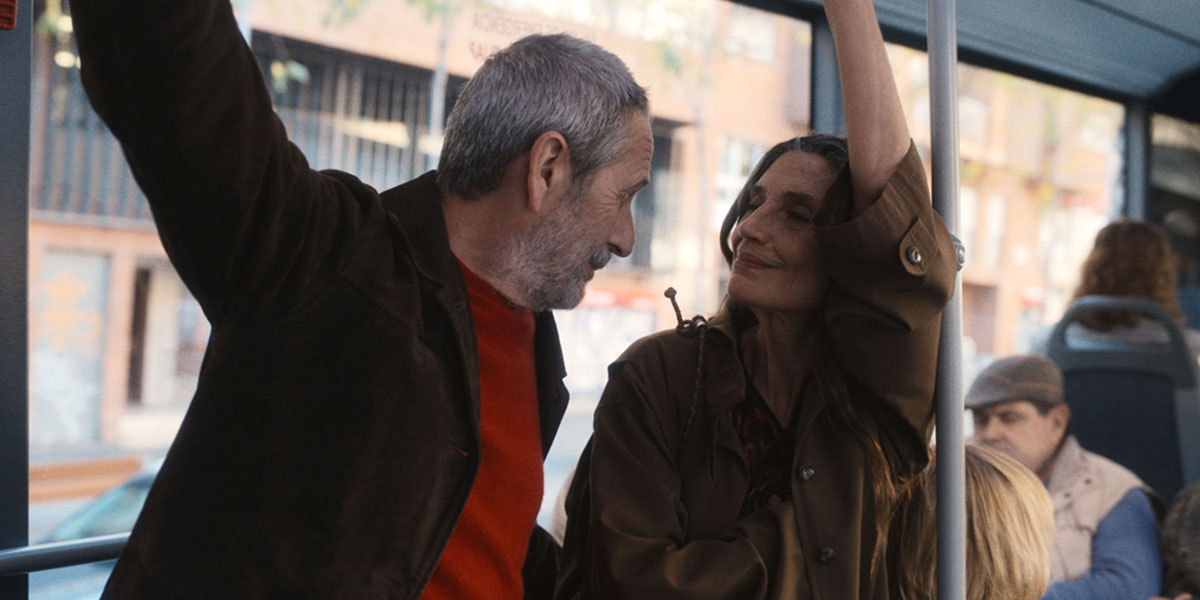
SS: You mentioned that your films incorporate dance and i also noticed that you’re very interested in couples and relationships. What was it about this particular couple that most fascinated you?
CMM: It was fun to do because I’ve worked with three movies with couples of my age. And to me it was nice because I don’t make movies about my life necessarily. I’m making movies about things that are surrounding me. And actually what happened to me many times is, I write something and then I live it afterwards. But it’s not like I’m going to talk about what I live. I’m interested to see what’s coming in my life. And then I like to explore it through movies to understand better.
But this one was a bigger job, suddenly going with an older couple. And I think to me, it was also to see how much can I stretch realism to make it appear as a different thing, you know? And it was a lot of fun to make these very opposite characters. That’s something that comes with age. At some moment, you lose track, I feel, at a certain age with a couple, the limit between love and dependency. And we try to always think of dependency as something bad. But actually, love and dependency, they are together, you know? You depend on the other person. And it’s beautiful. We live in this individualistic society. Obviously, dependency can be really sick, but also really beautiful. And I like to explore this limit and also bring these extremely opposite characters together.
SS: Flavio’s decision to die is quite provocative. How has that character been received by audiences?
CMM: I was afraid because it’s a very complicated thing and it’s a very delicate situation. In Switzerland it’s not euthanasia, it’s assisted suicide because the law is different. And it allows you to help somebody to die, to end their lives, but you have to do it yourself. You have to be able to drink the glass. It’s a very old law that comes from the Second World War, when they were a neutral country. It’s a very long story, but it’s a different law from the rest of the world. And I wanted to open the conversation. Because I think if we don’t talk about it, we are not able to communicate. It’s something that people can do out of desperation. So that was a little bit of my fear in doing this.
So we were trying always to calibrate the script so you kind of understand and go into this process and accept what a personal decision this is. A decision that’s very hard to understand. And I was surprised yesterday (at the world premiere). I was surprised that people understood. And I was very happy about it because it was always one of my fears with this script. If people don’t understand what he’s doing, the movie doesn’t work, you know? And I was glad to hear that we managed to make people feel it enough so we understand it.
[This interview has been edited for length and clarity]


Comments
Loading…