
 Shane Slater
In 2018, Meryam Joobeur garnered major attention with her Oscar-nominated short film Brotherhood. Exploring the impact on a Tunisian family when a son returns from fighting with ISIS, that filmmaking experience inspired her to expand the story. Six years later, Joobeur’s powerful debut feature Who Do I Belong To is now set to captivate audiences further, adding a more female-centric focus to the narrative. Ahead of its world premiere at the Berlin Film Festival, Awards Radar talked with Joobeur to discuss the film’s themes and its thought-provoking complexities.
Shane Slater: I interviewed you a few years ago for your short Brotherhood and you had mentioned that during the making of that film, it motivated you to do a feature. What were you most intrigued about exploring this time around with this more expansive story?
Meryam Joobeur: When I was shooting the short, I found myself much more drawn to the female characters in the family. So the mother character and then the Syrian wife. And that curiosity led to this question of, what if this happened instead? So, even though the films have a similar context, for me, it felt like I was working on a whole new story. Because I was like, what if this happened instead? And that led to a very inspiring cascade of ideas and avenues in which to take the feature.
SS: Your lead actress Salha Nasraoui is excellent. I could just feel the weight of everything her character was dealing with. What was it like working with her and getting her into that mental space for this film?
MJ: The beautiful part of making this feature honestly, is it really deepened my relationship with the actors. Salha and I became very close. Especially because she trained the brothers in acting over a period of two years. So we would live together for a few weeks, so that we could train the brothers. And in doing that, it kind of created a very close bond between all of us. Between me and her, and me and the brothers, and her and the brothers.
So I feel like you can really feel the proximity she has with the brothers who played her sons in the film. And she’s a mother herself. So that subject, I don’t think it was difficult for her to project. How painful it would be to live through something like that. And I’m extremely grateful for her. Her willingness to go where she did, because she was very naked in the film, very raw. I think it’s a testament to her talent, but also the trust her and I built over the years. The love and the trust. And I know that she feels the same, that because of the intimacy we have, she felt secure to go there. And that moves me a lot as a director and as a person.
SS: The character of Reem is also very integral to this story. Andwhile I was watching, I was thinking about the challenge of directing someone who’s face and body is very covered and subdued. What was it like to work with her as compared to the other cast members?
MJ: That was kind of an interesting challenge, right? How do we depict her and how do we approach her as a character? And obviously, when I was looking for an actress to play Reem, since she can only really express herself mostly through her eyes, I wanted somebody whose eyes speak volumes. So of course, Dea fit the bill. And also, I was looking for somebody who had an extensive theatre background for the physicality, to bring something interesting physically with the character. So, Dea was actually the first and only actress I really spoke to about the role.
So we had years as well to discuss. And she also came to Tunisia at some point before the shoot to spend time with the brothers and Salha. And I got to know her very well, and build also a close relationship with her. So together we’re like, “Okay, what’s her backstory?” Even in choosing all the elements of her costume. That was something we discussed. How to best convey her backstory. She has her eyes and her hands. And I do think they did an incredible job with her hands in the film. They convey a lot. But it was also about, like, what nail polish would she have? Or what state would the nail polish be in? We were really into details.
I’m very protective of that character. It’s actually emotional for me to talk about that character, because I feel like she represents a lot of women. She represents a lot of women who can’t speak, you know? I felt a huge responsibility with that character. And luckily, Dea as well. And, yeah, we just talked a lot. We saw what we could bring from the stories we read about and heard, and what we could bring from ourselves.
SS: This is such a good companion piece to Four Daughters in exploring the topic of ISIS and its effect on society and families. In both films, we learn that families can be shunned for even being related to people involved with ISIS. How did you navigate this sensitive topic in terms of being both critical and humanizing?
MJ: Obviously, it’s a very complex balancing act. And, yes, whenever there’s extremism, there are victims everywhere. And there is no neat victim. This is something that I’ve been thinking about and reflecting on. The tendency to want things to fit in a neat little box. And it’s complex. There are the victims that are very easy to identify when there’s an extremist act. The ones that are violated physically, or killed or hurt. But there’s the family who live in the shame and the pain, the hurt.
And then in a lot of cases, I do believe that when you commit an extreme act of violence, you destroy yourself, you know? There’s an element of you destroying yourself. And I think it’s difficult, because I think a lot of the times – and that’s something we have a hard time with – the oppressor and the victim could be the same person. And it’s a very tough subject to address. But my feeling is, and I’ve been saying this a lot in interviews, if you look throughout history, and even today, there’s no culture, race, religion, that hasn’t enacted extreme acts of violence, right?
So this capacity for violence or evil is within all of us. And, unfortunately, sometimes I find in the “filtered conversation,” it seems like, we want to push it on to other cultures and faiths and religions. But no, it’s within all of us. And unless we acknowledge that, and look at it within ourselves, even in our interpersonal lives, then, unfortunately, you can create that. I don’t think there’s much difference between somebody who joins ISIS or a cult. I think those routes of doing something extreme, there’s something similar to them.
Of course, there are the inherent psychopaths that have no empathy. But I think the majority of the times, people are driven to do extreme acts out of resentment, out of unaddressed anger, out of the longing to belong, out of wounds. And of a lot of the times, we can maybe see it within generational trauma, within families.
So it’s a tough subject, and I don’t really feel like I can only speak about my personal perspective on it. I’m more interested in creating a conversation. I have no clear answers, but it’s really about, like I said, having a conversation that’s interesting. And a moment of introspection, you know? Because these big societal issues can be extremely overwhelming. In my perspective, the only thing we have agency over is ourselves. And now I’m at the phase in my life where I realize, okay, if I heal myself, maybe I can help heal my community. And maybe that leads to a ripple effect. But to tackle these big issues on my own? I can’t. All I can do is maybe heal myself, which is a tough journey. And then hope to make an impact within my own community.
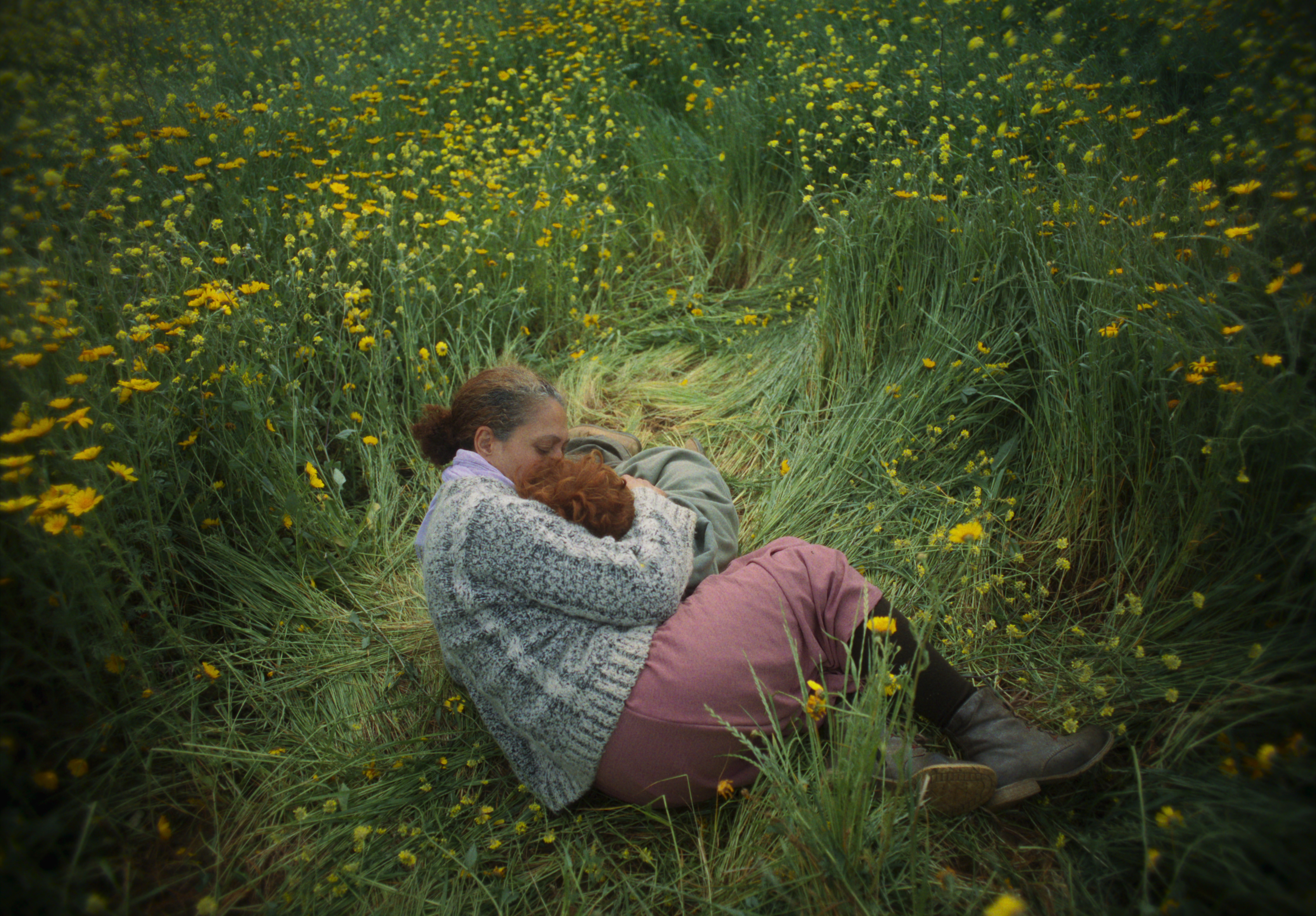
SS: You touched on the fact that extremism exists outside of this specific context, and I think the film’s visual language indirectly speaks to that. It’s intimate and specific but at the same time, the close-ups largely remove it from having an identifiable setting and makes it feel universal. Could you speak to the visual choices in the film, including also some of the wider shots used in the more surreal sequences?
MJ: That’s super interesting. I never thought that that could be kind of an effect of being close up, giving a sense of universality. It wasn’t intentional in that way. The thing is, my cinematographer and I have been working together since film school. So definitely, the visual language is, our collaboration resulted in that. And for me, I was just really passionate about this idea of just being able to access all the subtle nuances of the characters’ inner lives. Because a lot is expressed without words, I think. A lot has to be read through their eyes, through their little gestures, through a little breath.
And so, I think that probably I have a tendency to want to be close. Even Vincent makes fun of me, like, “We should get wide shots!” I was like, “No!” I do love wide shots. But it just has to be specific. But usually, I want to just get close. And so, I guess, as any director, I’m in love with my characters. And I feel so close to them that I want to be close to them.
It’s difficult to label the film, but I guess magical realism is the closest. So we wanted to see if we could blur that line of what is real and surreal. And so visually, we were inspired by photography a lot. We loved like the photography of Sally Mann for this. She was a big core. She was one of our pillars for the visual language. It was very instinctive as well. He would propose an idea, I would like it, and then it would just kind of flow from that.
SS: How has your outlook on ISIS and extremism been affected by the experience of making Brotherhood and Who Do I Belong To?
MJ: I mean, honestly, I would say the last five years of making this film was the most profound experience I’ve ever had. And it’s completely shifted my view on so many things. Making this film felt like unearthing everything. And everything is put into question. And I would answer that question most simply by referencing the title of the film, which is Who Do I Belong To? Because when I was editing the film, I realized that for the last couple of years, what I was trying to answer really, which was not on my conscious mind, was this question, who does my life belong to?
I had constructed an identity based on external expectations. And that identity definitely was crumbled, which was a very painful process. And I realize how, actually, it’s very dangerous to hold on to labels. It’s very dangerous. Of course, we construct an identity, but if we’re not playful with it, and we put our whole identity on something, then the moment that is shaken, that’s where I think we can hold on tight. I think holding onto your identity, labels of your identity, also can create extremism, you know? You can be so afraid to let it go.
In the case of the film, we see the characters holding on to their identity as the mother or the family man, or the victim in Mehdi’s case. It’s his dad, it’s always his dad’s fault, and he’s not taking personal responsibility. And holding on to that victimhood is also what results in him going. Because he’s seeking something else to validate that.
So, I think that’s the most powerful thing the film kind of made me face, is how at the end of the day, who does your life really belong to? And I had to really realize, I have to live the life I want. Not because it’s expected of me. I need to also be flexible with my identity. I can’t be just the good daughter. That’s not just my identity, I can be a little bit sassy sometimes. And it’s okay. I’m not going to lose my whole family because I was a bit sassy, you know? But I had held on to that identity for so long that being sassy became like a huge threat. I thought I was going to lose all my loved ones.
So that was the most powerful thing I learned from this film. And it’s something I’m still kind of digesting and learning. And that’s why it was important for me to share my personal question because it just was the cornerstone. I know that the title is unusual. But it was a title that I couldn’t have found more personal and meaningful. It’s everything for me. So, I hope that could be a conversation starter as well.
[This interview has been edited for length and clarity]


Comments
Loading…