

 Cory Stillman
While 9/11 is rightfully remembered in the United States and around the world as one of the most tragic and deadly terrorist attacks in aviation history, director Rippin Sindher is encouraging all of us to recall a similar tragedy which took place less than 20 years earlier, when a suitcase bomb brought down Air India Flight 182 off the Irish coast, killing everyone on board in the process. Sindher’s short film FLIGHT 182, executive produced by actress Archie Panjabi as well as legendary director Ridley Scott, follows a pregnant wife (Sundeep Morrison) as she races against time to prevent her husband from boarding the doomed flight amid intense political upheaval. The film’s 2025 release coincides with the 40th anniversary of the attack, which has been largely forgotten, even as it lingers in the minds of the affected communities today.
“For many of us in the South Asian community, it happened and was known yet it is not in textbooks,” says Sindher. “There are no museums let alone very much public acknowledgement of this tragedy.”
Sindher grew up with the knowledge that her own family was impacted by the Flight 182 attack, but it was not until the COVID-19 pandemic that she felt the courage to tell this story herself.
“That moment of collective vulnerability brought my own family’s history into sharp focus,” says Sindher.
With plans to eventually develop the short into a feature, it is clear that Sindher has tapped into something special with FLIGHT 182.
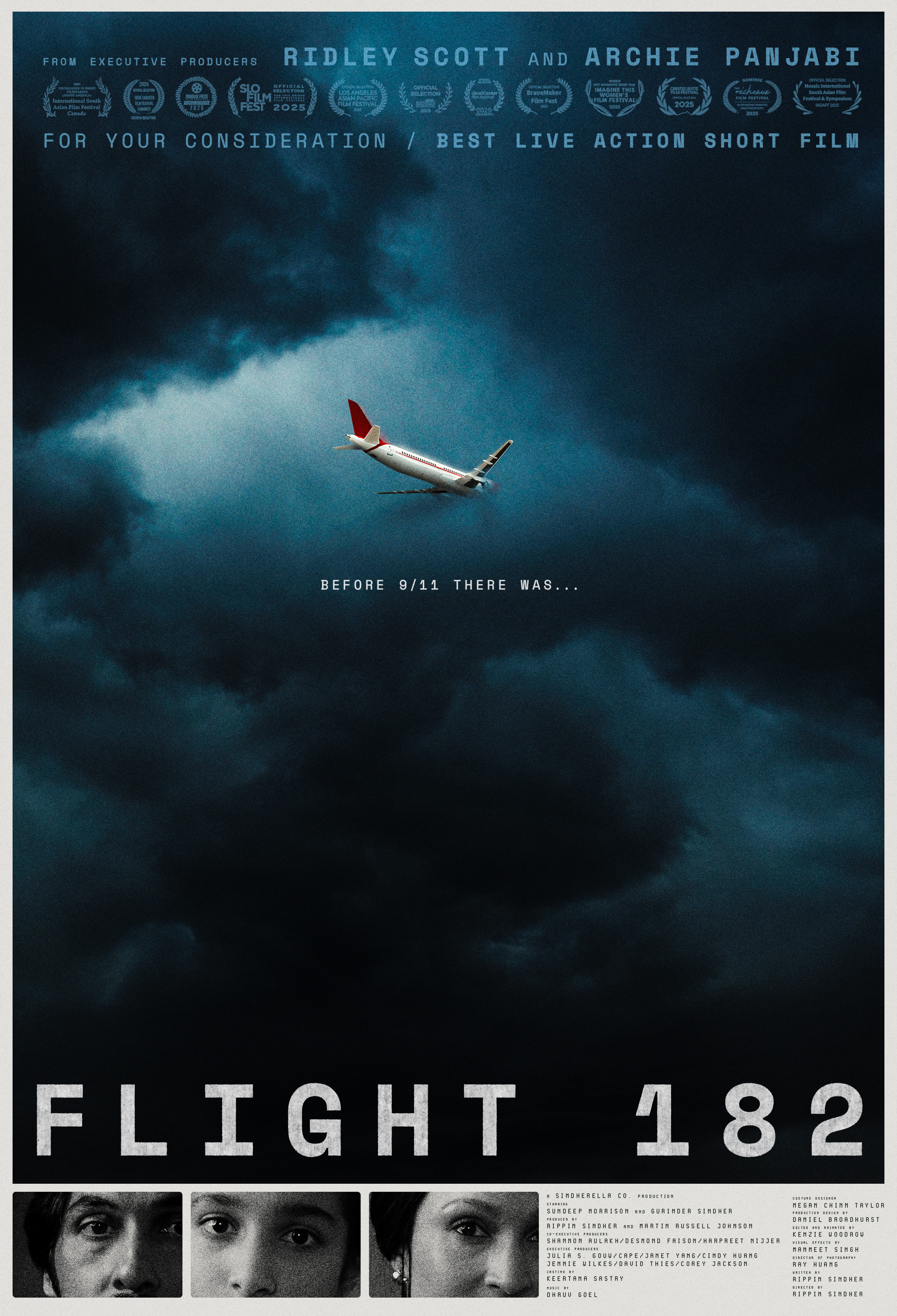
“Making this film is about honoring my loved ones, honoring the families who lost so much and finding a universal emotional connection through a very specific lens,” she says. “That’s the heartbeat of my work as a filmmaker.”
Check out our full conversation with Sindher below!
How did you first conceive of the idea for FLIGHT 182? What was your relationship to the tragic 1985 Air India Bombings?
There’s always been a quiet fear around what happened in 1985 when a suitcase bomb brought down Air India Flight 182 off the Irish coast, killing everyone on board. Because it happened in international waters and dissipated in the media, it became the longest trial in Canadian history. For many of us in the South Asian community, it happened and was known yet it is not in textbooks. There are no museums let alone very much public acknowledgement of this tragedy.
For me, the inspiration comes from personal loss and the shared pain of relatives whose lives were forever changed. I grew up with this story, and my background in sociology has always drawn me toward human-forward narratives. Stories that illuminate how ordinary people carry extraordinary trauma and the fight for truth. But it wasn’t until the pandemic, when that old fear of a loved one going into harm’s way resurfaced, that I finally found the courage to tell this story. That moment of collective vulnerability brought my own family’s history into sharp focus.
This film was greenlit by incredible AAPI women who believed deeply in its truth including Julia S. Gouw, Cindy Y. Huang, CAPE, Michelle Sugihara, and Janet Yang, the outgoing President of the Academy of Motion Picture Arts and Sciences. They were the earliest champions of this story. Through winning the Julia S. Gouw Short Film Challenge, they gave me the resources and confidence to bring this period piece to life in just 2.5 days. Their belief and financial support reminded me that this isn’t simply a film; it’s a responsibility to remember lives lost and to give voice to a history that has been overlooked for far too long.
How did executive producer Archie Panjabi get involved with the project?
Looking back, my connection with Archie Panjabi feels both completely unexpected and absolutely meant to be. We first crossed paths at the International South Asian Film Festival in Canada. She was being honored with the Icon Award, and I was premiering FLIGHT 182 in the very region where the real story began. I had nearly missed the event because I was working on an episode of S.W.A.T., but I arrived just as she stepped onstage.
I’ll never forget hearing her speak. It was one of the most heartfelt speeches I’ve ever witnessed. She had just come off Hulu’s Under the Bridge, portraying another real-life tragedy of the story of Reena Virk, and her performance had already stayed with me. In the South Asian community, Archie is more than an acclaimed actor; she’s a pioneer. That night, her message about perseverance, rejection and the responsibility of storytelling felt like it was directed straight at me.
I didn’t get a chance to speak with her in person because the crowd surrounded her. But I went home and sent her a message about how deeply her words had resonated. To my surprise, she already knew about FLIGHT 182 and had asked someone for a link. I shared the film with her, and shortly after, I received an email that now hangs in my office. In it, she wrote about how moved she was, how important this story is and that she would love to be involved.
That moment was the beginning of a powerful sisterhood and a true creative partnership. Archie didn’t just come on as an executive producer; she came on as someone who believed in the film’s heart, its purpose, and its place in honoring a history too many have forgotten.
I understand you are also developing a feature-length airplane thriller. What draws you to that particular setting in your work?
Yes, I’m developing the longer version of this story, and I always knew the short would serve as a proof of concept for a much larger vision with a film that could fully interrogate the justice system and the unanswered questions left behind. As someone who has experienced deep loss, I naturally channel that emotional truth into complex female characters searching for clarity in the midst of chaos.
With this feature, I finally have the space to explore the misaligned evidence, the systemic failures, and the human angles that have rarely been discussed publicly when it comes to this history. For me, it’s a form of memory justice. By remembering what happened, we create room for empathy, accountability, and a deeper understanding of how these tragedies shape generations.
Making this film is about honoring my loved ones, honoring the families who lost so much and finding a universal emotional connection through a very specific lens. That’s the heartbeat of my work as a filmmaker.
The feature script has already gained meaningful traction. It was a finalist for the Sundance Cultural Impact Residency and was selected for Circle Pitch Day through Dan Lin’s Rideback Rise accelerator. All of that reinforces for me that this story deserves a larger canvas and that audiences are ready to engage with it on a deeper, more expansive level.
What has your experience been like bringing this film on the festival circuit?
We began in the hometown connected to the real origin story — at iSAFF Canada — where so much of my family was able to attend. To screen FLIGHT 182 with loved ones present, and to honor my uncle’s life in that space, was emotional in a way I’ll never forget. It also showed me how deeply audiences connect to this story.
Since then, I’ve traveled across the U.S. and internationally during this 40th anniversary year, and no matter where I go, the conversations are profound. Some people tell me they never knew this tragedy happened. Others share that they knew someone on the flight. And I receive personal letters about how the film resonates with their own experiences of love, loss, and family. That kind of response means more to me than any award.
I made this film to shine light on something deeply personal and human. Experiencing the festival run in such a grassroots way, supported by my community and organizations like CAPE, has been overwhelming in the best way. And to now be one of the first Punjabi Sikh women to have an Oscar-qualifying short in the Live Action category feels like a reflection of all the people who carried this story with me.
The film has a really striking and warm color palette. Can you tell us more about the creative considerations that went into the film’s overall aesthetic?
Thank you. The visual language of the film was one of the earliest creative decisions we made. Because FLIGHT 182 takes place the night before an unthinkable tragedy, I wanted the world to feel lived-in, warm, and intimate. The color palette needed to evoke nostalgia — the way family memories look in your mind, while also carrying an undercurrent of unease.
Working closely with my cinematographer, Ray Huang, we leaned into warm, soft shadows, and textured light to create an emotional contrast: a home filled with love and routine, framed against a growing sense of something shifting beneath the surface. We researched period references, studied weather patterns to inform lighting decision and South Asian homes in the 1980s.
Production design and costume design also played huge roles. Our production designer, Daniel Broadhurst, was incredible in creating the DNA of this film by bringing in layers of browns, maroons, and worn textures that reflected immigrant life in the mid-’80s — practical, modest, and full of character. We also relied on VHS recordings to build the nostalgia.
The palette became a way to honor that tenderness and to remind audiences that this story comes from a place of real love.
What is your assessment of the current state of South Asian representation in entertainment, both in front of and behind the camera?
On one hand, we’re seeing more South Asian talent in front of and behind the camera than ever before. There are filmmakers, writers, actors, and showrunners who are finally getting the space to tell stories on their own terms. And when that happens, you can feel the shift on screen. But we’re still in the early chapters of that evolution. There’s a long history of South Asian stories being flattened, or told through an outside lens, and we’re still undoing that. Behind the camera, especially in directing, cinematography, editing, and producing…South Asian voices, and especially South Asian women, are still vastly underrepresented. There are rooms we’re just now entering for the first time. What gives me hope is the momentum and the community that’s building. When a film like FLIGHT 182 is supported by organizations like CAPE, or when icons like Archie Panjabi and Janet Yang champion a story rooted in our history, it signals that audiences are ready for nuanced, culturally specific narratives that still feel universal. It also shows younger creators that there’s a path forward and that our stories matter. Representation isn’t just about visibility; it’s about authorship. The more we expand who gets to tell the story, the richer and more human our industry becomes. And I’m grateful to be part of that wave, contributing one story at a time.
With this year marking the 40th anniversary of this historic tragedy, what makes this story so important to share with the world today?
This year marks 40 years since the Air India tragedy, and in many ways, the world is only just beginning to acknowledge the depth of what happened. For decades, this story lived in silence; absent from textbooks, museums and public discourse. Yet it remains one of the largest aviation attacks before 9/11. When a tragedy is erased or minimized, the people who lived it carry that weight alone. That silence becomes its own kind of injustice.
Sharing this story now is important because remembrance is a form of accountability. It forces us to confront the systems that failed these families like overlooked warnings, the lack of urgency and how international politics shaped the response. And in a global climate where fear, extremism, and disinformation still exist, understanding the past is vital.
FLIGHT 182 is ultimately about humanity. About a family the night before everything changes. That emotional entry point allows people from all backgrounds to see themselves in the story. No matter where I screen the film, audiences connect with the universal themes: love, loss, motherhood and the fragility of life.
The 40th anniversary isn’t just a milestone; it’s a reminder. A reminder that stories don’t disappear just because we stop talking about them. They live in families, in communities, and in the generational echoes of grief. Sharing this story today is a way to honor those lives, acknowledge the truth and ensure that this chapter of history is remembered.
Is there anything else you would like to share about FLIGHT 182 as it contends for an Oscar this awards season?
What I’d love to share is how profoundly grateful I am. FLIGHT 182 was made with so much heart in 2.5 shoot days, on a grassroots budget, and powered by a community that believed this story deserved to be remembered. To see it now in Oscar contention is something I could never have imagined as a kid growing up in a farm town, watching my parents work in the fields.
But beyond the awards conversation, what means the most to me is how audiences have embraced the film. People from all backgrounds — South Asian and beyond — have written to me, shared their own stories of loss, or told me they never knew this tragedy happened. That human connection is the real reward. If this film creates space for remembrance, healing, or conversation, then its purpose is already fulfilled.
I’m also deeply thankful for the champions Corey Jackon and David Thies whose support allowed me to make a period film against all odds and honor the families who endured the unthinkable and now, Ridley Scott who I am so grateful to have support this film.
This film is a love letter to the lives lost. No matter what happens this awards season, I’m proud to have contributed even a small part to ensuring this history is finally seen and acknowledged.


Comments
Loading…