
 Danny Jarabek
The Netflix series All the Light We Cannot See directed by Shawn Levy follows the lives of Marie-Laure, a blind French girl, and Werner Pfenning, a German boy, as they are forced to fight for the Nazi regime during World War II. Based on the adaptation of Anthony Doerr’s 2014 war novel of the same name, Levy decided to authentically portray the central role of Marie-Laure, who is a blind character in the story, with a blind or low-vision actress. Aria Mia Loberti, a PhD candidate at the time, responded to the global casting call with her first-ever acting audition. Aria’s display of screen presence and intelligence in the audition tape quickly convinced Levy and crew that she was perfect for the role of Marie-Laure over thousands of other applications.
Praised by critics and audiences alike, Aria’s performance at the center of the series is not only transcendent on-screen but also an important moment of representation. In our conversation, we discuss the support and experiences she had on-set working with director Shawn Levy, as well as with fellow castmates Louis Hofmann, Marion Bailey, Lars Eidinger, and Mark Ruffalo. Aria also speaks to the privilege of expressing the spectrum of the blind and low-vision community and her hopes that the role will continue to open more doors in the future for disabled actors. From auditionee to advocate, her journey is one of courage, growth, and authenticity that is only just beginning.
Read our full conversation below with star of the Netflix series, All the Light We Cannot See, Aria Mia Loberti.
Hi, this is Danny Jarabek here with Awards Radar, and I am very delighted to have with me today Aria Mia Loberti, star of the Netflix series, All the Light We Cannot See. Aria, how are you today? Thank you so much for joining me.
Aria: I’m not bad at all. Thank you so much! It’s really good to be here. Thanks for having me.
Of course. I am so excited to chat with you because your work in this role is absolutely incredible, and it is truly an honor to be speaking with you regarding just the history legacy, and importance of this role, too.
Aria: Thank you.
I want to hear from you what your initial reaction was when you heard about this opportunity to potentially audition for a major TV production. What was the feeling when you eventually heard about it and it crossed your path?
Aria: It’s so funny because I heard about it from a teacher that I hadn’t talked to in years. She sort of knew what I was up to. She knew I didn’t act. I had never acted, really. I’d never taken an acting class. Like, she knew that this wasn’t my sphere, and she sent it to me anyway. I remember just getting it and being like, “Oh, this is really cool.” You don’t see people doing searches anymore, and I was the Harry Potter generation, so I grew up seeing those types of casting searches and being like, “Oh boy, so I wish I lived in the Central London area, and I could audition for Hermione.” Whatever. So, I think that was mostly my reaction. It was like, oh, this is going to be such a cool opportunity for someone. I think those things just don’t happen anymore, so I didn’t expect it to go to an unknown. I was like, oh, I wonder who’s going to get it, and I was envisioning my favorite actresses in the part. I was kind of at a rough mental health place, so I wasn’t thinking about actually submitting anything myself, but I loved the book. A couple of days went by after she sent this to me, and I was like, oh, I could actually send something in. They say you don’t have to know how to act. I like the book, I’ll just do it. And you know what? If I’m kind of feeling upset and sad this week, that’s one hour where I have to feel someone else’s sad and not mine, so that’s okay. I sent it in. I did one take in my bedroom. I didn’t know how you do these things, so I read the lines sort of like, “Papa, where are we going to go?” It was a mess, but they must have seen something in it. Either that or they were just like, “Wow, this person has the confidence to make an idiot out of herself,” and that was it. It was very unexpected.
I mean, that’s so lovely to hear that. Did you have any interest in acting at any other point in your life? Was it something that you had maybe grown up dreaming about at all?
Aria: I mean, yes and no. I definitely always wanted to do it. It was always something that interested me that I thought was really cool. I was such a movie kid growing up. I was really into old movies and the Golden Age of Hollywood, and I just never did it myself. I was infatuated by it, I guess. So, I can’t say that I dreamed about it, but it also is sort of something that I would have pursued. If my family lived in New York or LA or something, I’m sure I would have pursued something, but we lived in a small town and those kinds of opportunities weren’t there. so I never looked into them. I was a dancer. I was a classical ballerina. I feel like that’s kind of adjacent.
Yeah, absolutely. Performance. I recently also spoke with a couple of the casting directors and got to hear a little bit of their insight on just the audition process with you and the relationship they got to develop with you. Can you speak to that from your end of things? What it meant to have them helping you through the process but also seeing in you the potential to make an extraordinary contribution to this role.
Aria: It was so crazy because I remember vividly my very first call. I sent my tape in on a Thursday, and I think I met with the casting director for the US portion of the search, Susanne [Scheel], on a Tuesday or Wednesday after that. And she was like, “Before we read, you look petrified, sweetie. Before we read, any questions?” And I’m like, “What’s a casting director?” I remember that so vividly. She sat with me for a good twenty minutes and walked me through what she did, what her casting associate did, what this would look like, and who was doing it. She just spent this time with some unknown girl in college who clearly didn’t know anything. And that was, I think, such a boost of confidence for me. I mean, just the fact that someone would be kind enough with their time and knowing now that they were seeing thousands of girls for this, is crazy. Before I opened my mouth and read a line with her. Then, later in the week or the following week, I met with Lucy [Bevan] and Emily [Brockmann] in England. This was all via Zoom. They were just so warm and welcoming, and I loved the audition process so much because of them. I mean, Shawn [Levy] was a big part of it too, but the casting directors were the major part. That was what got me to feel like throughout this process like … I wasn’t looking for an end result from it. I wasn’t looking to get cast. I just really wanted to have a good experience and maybe it would give me the confidence to go audition for the improv troupe at Penn State. So, I’m like, okay. But it was just this really good experience, and I was so sad when it was coming to the end that I wouldn’t be able to spend time with them anymore. They were really wonderful. And when I did get cast, it was Lucy and Emily. I went in like, “Oh, I could 100% negotiate a deal with Netflix. I’m fully capable of this. I’m an independent woman. I’m almost done with a doctorate. I can do this, goddamn it.” And she’s like, “No, you can’t. You need a lawyer. I don’t care if you got accepted to law school. You need a lawyer for this.” She was the one who protected me and made sure that I got my lawyer. My lawyer and she were the people who set me up with my current reps. So, throughout the beginning of this process, they were my anchors. I think now that I’ve been in the industry for a whole two years, I feel like they’re the unsung heroes of this whole thing. They are the ones who are lifting us up so that we can go on screen and shine, and they don’t really get that credit. I just think they’re amazing people, and their job is so cool, too.
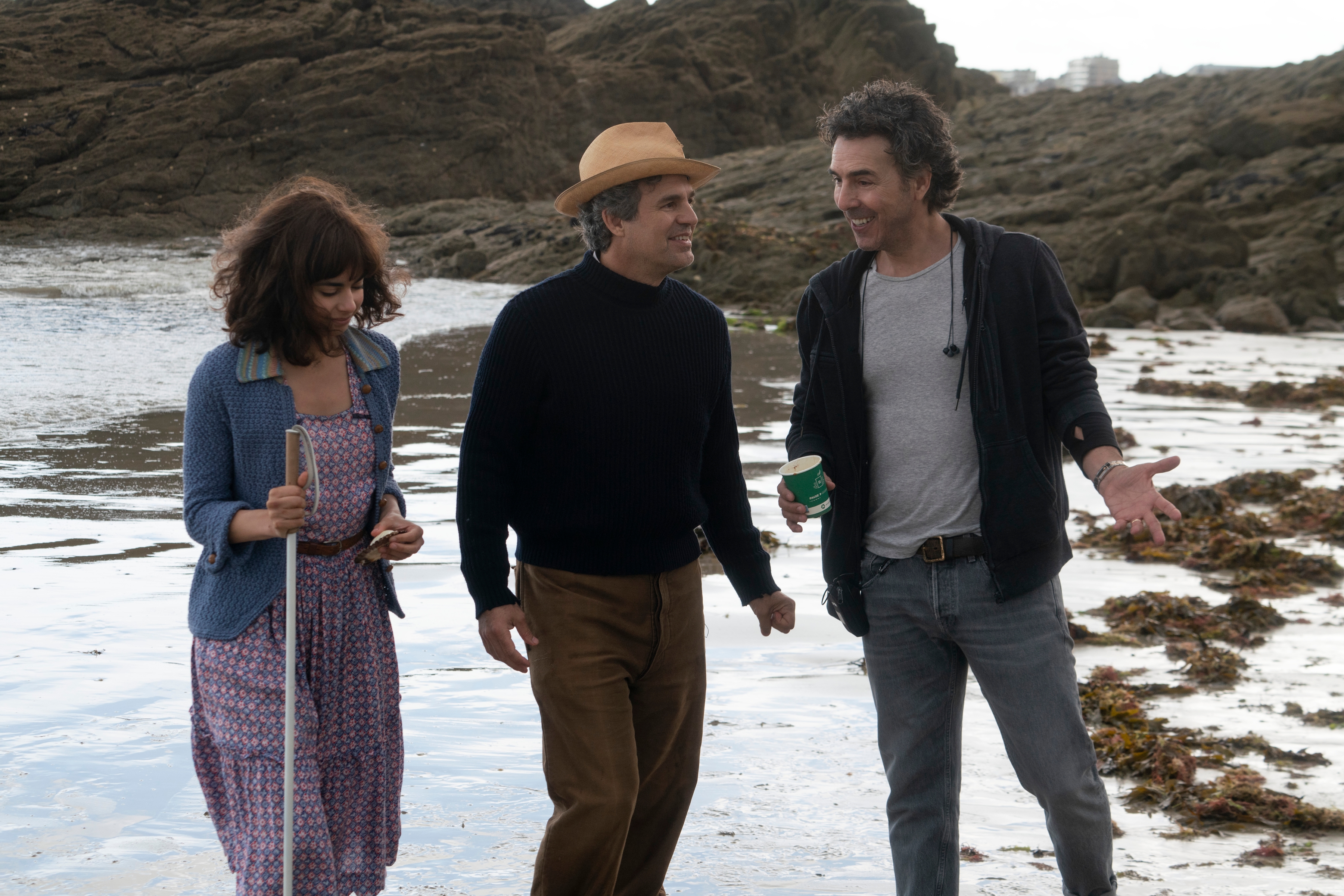
Yeah, that’s really great to hear. I love hearing that there was that support for you. And speaking to more support on the production side of things as well, what was it like when you got to set and you’re working with these veteran actors who have been around and done big movies and big TV shows for so many years? Were they helping you through the process at all? What was it like in that way?
Aria: Yeah. They were a huge help. I think it started with Shawn, mostly. They scheduled—I don’t know if it was intentional, I’m pretty sure it was—the first three weeks so that I would fly out, I wouldn’t have anything to film, and I would just watch Shawn filming Louis’s [Hofmann] scenes. So, Shawn, literally, I followed him around. I shadowed him for most of that time. I got to experience every layer of a film set from him making his shot list all the way through to him giving notes on a scene. Then, he allowed me to meet with the department heads and I learned what they did so that when I got to set I wasn’t like, “Why are there 400 people staring at me? Because I thought it was going to be me, Shawn, and a camera dude. I did not expect this.” So, that was really helpful that I got to learn from him. Then, Louis was also really extraordinary during this time because I had a lot of questions for him about acting. Like, “How do you do this?” This is a job. You understand fundamentally in your brain that it’s a job, but I had never spoken to someone who’d made a living that way. It was just really nice to have someone my age who had experience but was still fresh. It was one of his, if not his first, big American production. He’s doing it in a language that isn’t his native language. So, we were both thrown in the deep end and even though it was very different, I was just really grateful for that relationship. And then my relationship with Mark [Ruffalo] I think is just really special, and it started before we even filmed. He asked if I would come to New York to meet him, and I did. It turned out it was pouring rain, and we had this whole nice outdoor day planned. We tried to do it. We just had the nicest time wandering around New York, and I was so muddy and filthy and wet by the end of it, but we had such a lovely time just connecting. We spent a lot of time together outside of set just trying to get that father-daughter relationship to look really genuine and also to feel really safe with each other. I credit a lot of my growth and artistry to Mark because I think without him without seeing his own fears and anxieties and without him walking me through so many things that he learned over his incredible, long career, I don’t think I would have been able to do anything. Also, I credit a lot of that to him. Then Hugh [Laurie], Marion [Bailey], and Lars [Eidinger], each in their own way, were just absolutely fantastic. Hugh, we talked so much about the theory, the craft, and what I studied. He was so interested in that and how so much of my academic work was based in words and wordplay. He helped me connect that to acting. Without him, I wouldn’t have been able to draw those connections and then see my own background as a strength that I can bring. Marion is girl power personified, just an extraordinary human being who I think deserves way more credit and I think should be mentioned more in this whole promotion bit. And then Lars, I wish that the audience would know that he’s a really nice person because it doesn’t come across at all. and the stuff we had to do together was crazy. It took such an amount of trust, the likes of which I’ve never had to have in a professional environment with anyone to do the types of things we did together. I’m really grateful to him for not only having the trust in me but also helping me, very similar to Hugh, work on my craft and work on my control. Because I didn’t know how to cry on cue. I didn’t know how to turn that down when someone yelled cut. Lars and Hugh, in separate measures, were a big part of me learning that control, which was really cool.
That’s really cool to hear. I’m very happy to hear also that you had that support system on set. That’s amazing. In finding this character that you were portraying, you said you were a fan of the book. Did you reference the material a lot in going back to developing the personality of this character, or did you find that in the production process?
Aria: It was a little bit of both. I think the coolest part in the very beginning for me was getting the script. And I got it, like, a week or so after I got cast. I was just excited to read a script for a book that I loved, so that was cool. Then, they were like, “Do you want to talk to Anthony Doerr?” And then I just died, and I don’t know what happened. I was so petrified to speak to him because I loved the book so much. It’s so cool. I remember peppering him with questions, and I had a whole page of notes that I had taken from that conversation. And then I went back and read the book again, and I pulled out all of her passages. Because the book is written in a state of temporal flux, I pulled out her passages in chronological order and matched them to stuff in the script. I had spreadsheets, and I was writing from her perspective. I’m also a writer, so I was writing scenes from her perspective and trying to find her voice that way because that was how I knew how to do it. Especially coming from an academic background, it was way easier for me to look at the text and be like, “You need to achieve X, Y, and Z in the scene,” the same way I would if I were writing a paper. I think a lot of it came from an understanding that the medium was different. I think that was the hardest thing for me to do, because I knew the book well, and I knew that the script obviously had to cut scenes and change things, and we’re not in her brain, and figuring out how to achieve the same feeling or the same sense that I had when I read her scenes in the book but on screen in a visual way. So, I think a lot of my time was spent really understanding how to work in the medium, the same way I had to understand how to work as a writer and how to do different genres as a writer. It was one of the longest parts of this process for me. And then I ended up pairing all of that technical stuff to scents and songs so that when I got on set, I had sort of Pavlov’s dogged myself to certain things. After that, it was just learning the control and talking to someone like Shawn or talking to my scene partner to make sure that … because I was learning as I was doing it. I didn’t know anything. So, making sure that my instinct was right, which sometimes it really was not right, and having to go back and look at that source material again, whether it was the script or the book, and figure out what I needed to do behaviorally to capture it for an audience who wouldn’t be in my head at the time if that makes sense.
That makes so much sense. And I love just the depth of technique that you’re clearly showing and bringing to this because when you’re on screen, it feels so effortless when I’m watching it.
Aria: Thank you!
But I love hearing how much you put into this in the background. That is really incredible to hear. And I was also going to ask, as a student myself, and I know that you have been in academics for a while as well, how that kind of background helped inform, as well, what you were doing. You alluded to it a little bit as well kind of in the writing process.
Aria: Yeah. Honestly, I think when I started, there was so much of this back current of conversation that was ‘overintellectualizing is going to be really bad for you.’ And I think that’s 100% true, but I think that scared me a lot in the beginning and made me feel like I wasn’t going to be able to find my groove, I guess. I don’t know. At the end of the day, I think it was the biggest strength that I could bring. Production was really wonderful because they allowed me to work with an acting coach leading up to filming. And we did this for a couple of months, at most, and I wanted to work on scenes with him. I wanted to literally read the scene and practice the facial expressions. and either in a Zoom screen or in a mirror, figure out what my face is doing and figure out how to do certain emotions. All these things that I just didn’t know. And he was like, “First of all, acting isn’t about a display of emotion. It’s about a display of behavior that then triggers in the audience the emotion.” I think what’s so interesting is, coming from a background of studying essentially why words have power and why our minds have certain capabilities, taking this short fuse and understanding how that works in an audience or from the relationship between an actor and audience really helped me because I think I would have really struggled if I didn’t have the background that it came from. And then, you add onto it the background that I had as a ballerina, which was so physical. Storytelling without words at all. Understanding it the way he taught me through the lens of behavior and not emotion, not my own emotion, was quite helpful because my instinct is how do I make myself cry? How do I bring myself back to the deepest trauma I’ve ever felt so that the audience can feel it too, that’s not what this is about. And I think that if I hadn’t grounded myself in literal years of academic work and then had that couple of years of experience as a professional academic, I wouldn’t have felt like I could have grounded myself. Part of that is just I didn’t come into it when I was sixteen. I came into it as an adult, and I think that’s equally as important as all of the fun degrees.

One last question for you before I let you go. I know that this is an incredibly important moment, I think, in bringing visibility and exposure to a community that is underrepresented on screen. Do you hope to have any impact on bringing more opportunities to this community and other underrepresented communities in that way?
Aria: Yeah. It’s honestly been one of the coolest parts of this whole process. It’s a real privilege. I mean, obviously, making a show like this is a privilege by itself, but then to be able to say that I could open the door for so many people is probably one of the biggest privileges of my life. I think what’s really special about this circumstance is, and again, this comes from someone who’s studied media history, is oftentimes we are introduced to a particular “marginalized”—I don’t really like that word—community through stereotypes and stigmas first. And that’s definitely the case for disability. We have these sort of tropes that we’ve grown up with, with the vacant expression and everyone can just see totally black if you’re blind. All this stuff. That’s certainly been the case, but we haven’t really seen with this population people with disabilities being forced to put on those tropes the same way we have in other populations throughout film history. And I think what I’m really grateful for is that, for some reason, we’ve circumvented that process and have gone right to authenticity. So, I’m really, really grateful for that. And I think another layer to this that is so important for me to express is the spectrum of the community. I’m very much a person with sight. Like, I read books. I draw. I use my sight. But that doesn’t mean that I don’t have low vision. That doesn’t mean that I’m not a part of this community. If I’m on this side of the spectrum and Marie-Laure [LeBlanc] is over here, and she has no sight to use, she is maybe 7% of the blind community. The other 93%-ish of us are somewhere between here and here. I might be on the further end of that spectrum, but my experiences, and my upbringing, still allow me to have a voice to an authentic character anywhere on the spectrum. They also allow me to maybe break a glass ceiling that hasn’t been shattered before because I don’t believe that people should be really held down to roles that only portray certain qualities of their identity. I think that’s wrong. And it’s been cool for me to introduce people to that whole spectrum and to understand that this is an authentic representation of a character like Marie because of the lived experiences I’ve had and because of the history of this population. But there’s so much room for space and improvement and growth. And that’s what I’m excited to see, that we can see the spectrum of blindness on screen represented. So, this may be people who look differently than the sighted community. I don’t fall into that category, but I’d love to see someone lead a movie who does and bring a whole new layer to this and a whole new sense of expression. And if I can open the door for them, I feel like I’ve done my job well. In the meantime, I think the best thing that I can do is live my life to the fullest and not make this a huge part of how I present myself to the world because we’re all just people living our lives. That’s the kind of representation we need, and that’s what I’m excited to be able to bring.
I think that is admirable, and I completely share all of the sentiments regarding my hope that this continues to open more doors, open more conversations, and open more visibility. So, thank you so much for this performance. Thank you so much for your courage. Thank you so much for doing all of the things that you’re doing. It is incredibly admirable and brave. I want to thank you again for your time. It was wonderful to chat with you, and I loved getting to hear a little bit more behind the scenes of this incredible role and this incredible series. So, thank you.
Aria: Same here. Thank you so much! It’s so cool to be able to share the experience. It’s so crazy. I appreciate it. I was looking forward to this. Thank you so much.
Of course. I hope you have a great rest of your day, and I can’t wait to write up this piece and share it with share it with the world.
Aria: Thank you so much. I can’t wait to read it. Thank you.


Comments
Loading…